Ctrl K
1759–1816
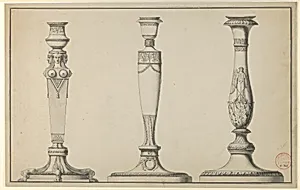
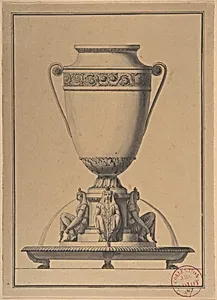
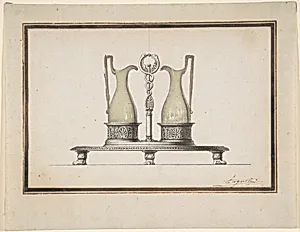
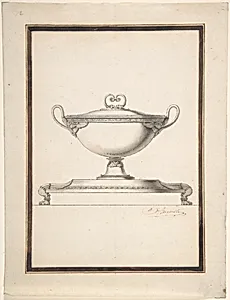
**Henri Auguste (1759–1816)** was a leading Parisian gold- and silversmith renowned for his elegant neoclassical and Empire-style works in *orfèvrerie*. As the only son of the royal goldsmith Robert-Joseph Auguste (1723–1805), he assumed ownership of his father’s workshop in 1784–85 and carried forward the family tradition of refined, classically inspired silverware.
Auguste collaborated closely with the sculptor Jean Guillaume Moitte, who supplied designs and models that helped establish him as one of the foremost creators of Empire-style silver, rivaling contemporaries such as Jean-Baptiste-Claude Odiot and Martin-Guillaume Biennais. He received official patronage from Louis XVI starting in 1784 and later from Napoleon, for whom he produced a magnificent 425-piece silver service commissioned by the City of Paris in connection with the emperor’s 1804 coronation. Of this grand service, twenty-four surviving pieces are now displayed in the dining room of the Château de Malmaison.
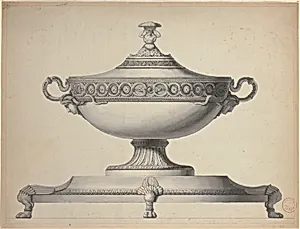
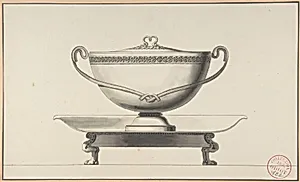
Among his notable private commissions was a silver-gilt tureen and stand made in 1787 for the Neapolitan ambassador Tommaso Somma, marchese di Circello (now in the Royal Collection), as well as several ewers and basins acquired by the British collector William Beckford between 1788 and 1802. Auguste received a gold medal at the 1802 Exposition des produits de l’industrie française, underscoring his prominence during the Napoleonic era.
Financial difficulties led to his bankruptcy in 1806; after an unsuccessful attempt to flee France in 1809, he escaped to England and ultimately died in Jamaica in 1816. His legacy endures through the surviving masterpieces that exemplify the transition from late-eighteenth-century neoclassicism to the bold, imperial grandeur of the Empire style, with many works preserved in major public and royal collections.
![Inscription [reverse]](https://images.artheonmuseum.org/nga/thumb/inscription-reverse-nga-126833.webp)
![Henri de La Tour d'Auvergne, 1611-1675, Vicomte de Turenne, Marshal of France 1643 [obverse]](https://images.artheonmuseum.org/nga/thumb/henri-de-la-tour-dauvergne-1611-1675-vicomte-de-nga-126834.webp)