
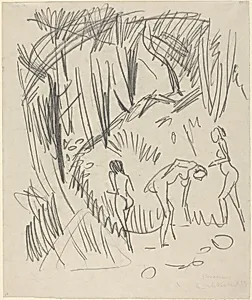
Three Figures
1913
Medium
graphite on wove paper
Dimensions
overall: 46.4 x 38.9 cm (18 1/4 x 15 5/16 in.)
Classification
Drawing
Department
CG-W
Museum
National Gallery of Art, Washington, D.C.
Credit
Rosenwald Collection
Accession Number
1950.17.307
Rights
Public Domain
Art Historical Context
**Three Figures** (1913) by Erichel captures the raw emotional intensity characteristic of German Expressionism. Heckel, a founding member the revolutionary group Die Brücke—formed in Dresden in 5—was part of a young generation of artists rejecting academic traditions in favor of primal, distorted forms and vivid expression. This drawing, created on the eve of World War I, reflects the fascination with the human figure as a vessel for inner turmoil and vitality, often drawing inspiration from primal art and urban life. Rendered in graphite on wove paper—a smooth, versatile support ideal for nuanced shading and line work—the piece measures 46.4 x 38.9 cm. Heckel's economical yet forceful lines and tonal modeling evoke movement and psychological depth, hallmarks of his draftsmanship. Drawings like this were central to Die Brücke's practice, serving as both studies and standalone works that prioritized spontaneity over polish. Housed in the National Gallery of Art's Rosenwald Collection (Department CG-W), **Three Figures** exemplifies early 20th-century innovation in modern drawing. It invites viewers to ponder the figures' enigmatic poses amid a time of artistic and social upheaval, bridging personal expression with broader cultural shifts toward modernism.
About the Artist
Erich Heckel · 1883–1970
Erich Heckel (1883–1970) was born in Döbeln, Saxony, the son of a railway engineer. He attended the Realgymnasium in Chemnitz and went on to study architecture in Dresden, where he encountered the fellow students who would become his closest artistic collaborators. In 1905, together with Ernst Ludwig Kirchner, Karl Schmidt-Rottluff, and Fritz Bleyl, Heckel co-founded Die Brücke — The Bridge — an E...