
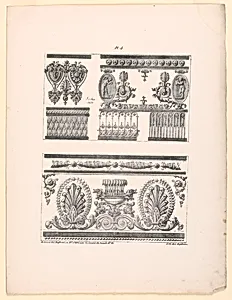
Three Friezes, plate 4 fr
Medium
ornament
Classification
ornament
Department
Smithsonian Collection
Museum
Smithsonian American Art Museum
Credit
Gift of Eleanor and Sarah Hewitt
Accession Number
1925-2-188
Rights
Public Domain
About this artwork
Research in Progress
Art Historical Context
**Three Friezes, Plate 4 (fr)** *Gottfried Engelmann, 3* Lithograph on paper (ornament) *Gift of Eleanor and Sarah, Smithsonian American Art MuseumCreated in 1823 by pioneering lithographer Gottfried Engelmann (178–1839), *Three Friezes, 4* showcases the artist's mastery of early lithography, a revolutionary printing technique invented just two decades earlier. Born in Germany and active in France, Engelmann helped popularize the medium for reproducing intricate designs with remarkable fidelity. This plate, part of a series of ornamental motifs, features three classical friezes—repeating decorative bands often inspired by ancient Greek and Roman architecture—rendered in fine detail on paper. In the early 19th century, such ornamental prints were essential tools for architects, designers, and craftsmen during the Neoclassical revival. They served as pattern books, disseminating elegant motifs for interiors, furniture, and public buildings amid the Empire style's grandeur. Engelmann's precise lithography captured the subtle textures and symmetries of these friezes, making high-quality designs accessible beyond elite workshops. Donated to the Smithsonian American Art Museum by Eleanor and Sarah Hewitt, this work highlights the intersection of art, technology, and design history—though ongoing research promises deeper insights into its exact inspirations. A testament to lithography's transformative power!