
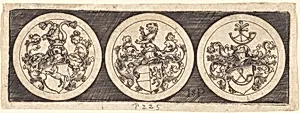
Three Medals with Coats of Arms
1401 to 1500
Medium
engraving
Classification
Department
CG-E
Museum
National Gallery of Art, Washington, D.C.
Credit
Rosenwald Collection
Accession Number
1943.3.1102
Rights
Public Domain
Art Historical Context
Behold *Three Medals with Coats of Arms*, a delicate engraving by the German artist Sebald Beham, dating to the late 15th or early 16th century (circa 1401–1500). Housed in the National Gallery of Art's Rosen Collection within the Prints department (CG-E), this work the precision of Renaissance printmaking. Beham, a master of small-scalegravings known as one the "Little Masters," three intricately detailed medals adorned with heraldic emblems—symbols of lineage, power, and identity central to European nobility during this era. Engraving, the medium here, was revolutionary in Beham's time, allowing artists to incise fine lines into metal plates for multiple impressions on paper. This technique democratized access to elaborate designs once reserved for sculpture or casting, making heraldic motifs portable and collectible. The coats of arms likely commemorate noble families or events, reflecting the Renaissance fascination with antiquity and personal legacy amid the Holy Roman Empire's vibrant courts. Visitors will appreciate the artwork's technical virtuosity: Beham's crisp lines and textures evoke the metallic sheen of real medals, blending Gothic intricacy with emerging humanist detail. A testament to early graphic art's cultural role, it invites us to ponder the enduring language of heraldry in an age of discovery and display.
About the Artist
Sebald Beham · 1500–1550
Sebald Beham (1500–1550), a pioneering German printmaker and painter born in Nuremberg, emerged as one of the most prolific artists of the Northern Renaissance. The elder brother of fellow artist Barthel Beham, he grew up in a milieu steeped in artistic tradition, though details of his early training remain sparsely documented. Recorded as a journeyman painter (Malergeselle) by 1521 and a master w...