
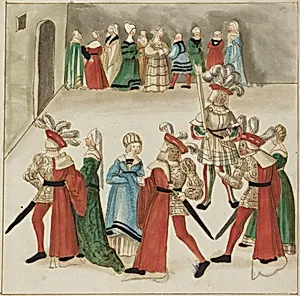
Three Men in Red Capes Dancing with Their Partners
c.1512-1515
Medium
pen and brown ink with watercolor on laid paper
Dimensions
image: 23.3 cm (9 3/16 in.) sheet: 33.7 x 27 cm (13 1/4 x 10 5/8 in.)
Classification
Drawing
Department
CG-E
Museum
National Gallery of Art, Washington, D.C.
Credit
Rosenwald Collection
Accession Number
1964.8.1763
Rights
Public Domain
Art Historical Context
This delicate drawing from around 1512–1515 captures three men in striking red capes as they whirl across the page with their partners. Created by an anonymous German artist of the early sixteenth century, the work uses pen and brown ink to define lively figures and flowing garments, while watercolor adds vibrant touches of color to the capes and costumes. On laid paper measuring roughly 34 by 27 centimeters, the scene feels spontaneous, as if the artist quickly recorded a moment of social merriment. In the early Renaissance north of the Alps, dance often marked festivals, courtly gatherings, or seasonal celebrations. The artist’s fluid lines convey movement and rhythm, suggesting an interest in human activity rather than static portraiture. The red capes may hint at festive or even military attire common in German lands during this period, reflecting both fashion and the era’s lively communal traditions. Housed in the National Gallery of Art’s Rosenwald Collection, the drawing offers a rare glimpse into everyday pleasures of the time. Its combination of precise draftsmanship and colorful accents highlights the growing sophistication of works on paper, which were increasingly valued as independent art forms rather than mere studies.
About the Artist
German 16th Century · 1500–1600
The designation "German 16th Century" refers to a collective of anonymous artists active during the height of the German Renaissance, a period marked by profound artistic innovation amid the Protestant Reformation and humanist revival. Little is known about the individual lives or training of these makers, as their identities remain undocumented, with works often attributed based on regional style...