
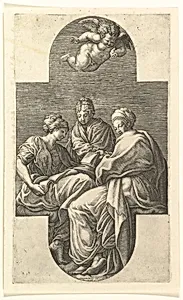
Three Muses and a Gesturing Putto
Medium
Engraving
Dimensions
sheet: 12 5/16 x 7 3/8 in. (31.2 x 18.8 cm)
Classification
Prints
Department
Drawings and Prints
Museum
Metropolitan Museum of Art, New York, NY
Credit
Harris Brisbane Dick Fund, 1926
Accession Number
26.50.1(165)
Rights
Public Domain
Tags
Art Historical Context
In the 1560s, Italian engraver Giorgio Ghisi masterfully reproduced a design by Francesco Primaticcio a leading Mannerist artist at the French court of Fontainebleau, this elegant *Three Muses and a Gesturing Putto Measuring 12 5/16 x 7 3/8 inches, the engraving captures the graceful, elongated figures emblematic of Mannerism—a stylish evolution from High Renaissance ideals, emphasizing elegance, artifice, and classical mythology. The three Muses, embodiments of poetry, music, and dance, flank a lively putto (a chubby, winged child symbolizing innocence and play), whose animated gesture draws the eye into their harmonious tableau. Engravings like this were revolutionary in the 16th century, allowing intricate designs to be widely disseminated across Europe, democratizing access to elite court art. Primaticcio's Fontainebleau School influence shines through in the fluid poses and decorative motifs, reflecting the era's humanist revival of antiquity amid royal patronage. Ghisi's precise burin work on copper plate ensures fine lines and rich tonal contrasts, making it a technical marvel. Today, this print from the Metropolitan Museum of Art's Drawings and Prints department (acquired via the Harris Brisbane Dick Fund in 1926) invites visitors to ponder the Muses' enduring inspiration for creativity. A delightful window into Renaissance print culture! (198 words)
About the Artist
Giorgio Ghisi|Francesco Primaticcio · 1520–1582
Giorgio Ghisi (c. 1520–1582) was one of the most accomplished engravers of the Italian Renaissance, renowned for translating the monumental compositions of Raphael, Giulio Romano, and Michelangelo into the exacting medium of the burin. Born in Mantua, he trained in an environment shaped by the legacy of Giulio Romano's decoration of the Palazzo del Te, and the grandeur of that Mannerist tradition ...