
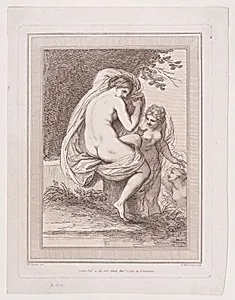
Three Nymphs Bathing
Medium
Etching and engraving, printed in brown ink; second state of two
Dimensions
Plate: 10 15/16 × 7 7/8 in. (27.8 × 20 cm) Sheet: 11 3/4 × 8 7/8 in. (29.8 × 22.5 cm)
Classification
Prints
Department
Drawings and Prints
Museum
Metropolitan Museum of Art, New York, NY
Credit
Harris Brisbane Dick Fund, 1917
Accession Number
17.3.449
Rights
Public Domain
Art Historical Context
"Three Nymphs Bathing," dated March 1, 1787, captures a serene classical scene of mythological figures in a natural setting Designed by the Italian-born painter Giovanni Battista Cipriani and engraved by Francesco Bartolozzi, the print reflects the late eighteenth-century fascination antiquity. Cipriani, active in England and a founding member of the Royal Academy, frequently supplied graceful, idealized subjects that Bartolozzi translated into print form for a wide audience. Executed in etching and engraving and printed in warm brown ink, the work showcases Bartolozzi’s refined technique, which allowed delicate lines and subtle tonal gradations to suggest soft flesh and flowing drapery. As the second state of two, it represents a refined impression carefully pulled to enhance these effects. Such reproductive prints played a vital cultural role, making neoclassical imagery available beyond elite collectors and helping shape public taste for harmonious, antique-inspired compositions. Housed today in the Metropolitan Museum of Art’s Department of Drawings and Prints, this sheet exemplifies the fruitful partnership between designer and engraver that flourished in Georgian London. Its modest yet elegant format invites viewers to appreciate both the timeless appeal of the nymphs’ tranquil moment and the technical artistry that preserved it for posterity.
About the Artist
Francesco Bartolozzi|Giovanni Battista Cipriani|Francesco Bartolozzi · 1727–1815
Francesco Bartolozzi (1727–1815) was an Italian engraver whose most productive period was spent in London, where he became the leading exponent of stipple engraving and a founding member of the Royal Academy. Born in Florence and trained first as a painter before turning to engraving in Venice, he established his reputation in Rome before being recruited by the English Royal Librarian Richard Dalt...