
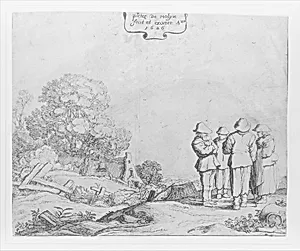
Three Peasants and a Woman
1626
Medium
Etching
Dimensions
sheet: 5 15/16 x 7 1/4 in. (15.1 x 18.4 cm)
Classification
Prints
Department
Drawings and Prints
Museum
Metropolitan Museum of Art, New York, NY
Credit
The Elisha Whittelsey Collection, The Elisha Whittelsey Fund, 1962
Accession Number
62.538.1
Rights
Public Domain
Tags
Art Historical Context
Step into the rustic world of 17th-century Netherlands with *Three Peasants and a Woman*, a etching by Pieter de Mol created in 1626. This intimate print, measuring just under 6 by 7 inches, captures snapshot of everyday rural life: three male peasants and a woman, likely going about their labors. Housed in the Metropolitan Museum of Art's Drawings and Prints department, it comes from The Elisha Whittelsey Collection, in 1962. Molijn, a key figure in the early Dutch Golden Age, was renowned for his landscape etchings that often featured humble figures amid dunes and fields, reflecting the era's growing fascination with the Dutch countryside. Etching—a revolutionary printmaking technique using acid to bite lines into a metal plate—allowed artists like Molijn to achieve fine, expressive details and subtle tones, making high-quality images accessible beyond paintings. This work exemplifies the period's shift toward genre scenes celebrating ordinary folk, amid Holland's economic boom from trade and agriculture. Its small scale invites close viewing, revealing the textures of clothing and faces that humanize these working-class subjects, offering visitors a poignant glimpse into Golden Age society's layered world.
About the Artist
Pieter de Molijn · 1595–1661
**Pieter de Molijn** (1595–1661) was a Dutch Golden Age landscape painter of English birth and Flemish descent, baptized on 6 April 1595 in London at the Dutch Reformed Austin Friars church to parents from Ghent and Brussels. His family likely emigrated to England for economic opportunities, but young Pieter returned to the Netherlands, settling in Haarlem where he joined the Guild of St. Luke in ...