
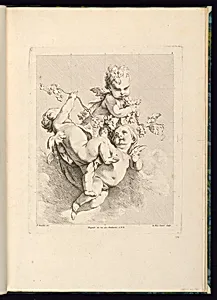
Three Putti
Medium
Classification
Department
Smithsonian Collection
Museum
Smithsonian American Art Museum
Credit
Purchased for the Museum by the Advisory Council
Accession Number
1921-6-247-14
Rights
Public Domain
About this artwork
Research in Progress
Art Historical Context
**Three Putti** *François Boucher (French, 1703–1770), 1749–61, Print* Smithsonian American Art Museum ançois Boucher, a figure of the French Rococo movement, captures the playful essence of 18th-century decorative art in *Three Putti*. Created between 1749 and 1761 during the lavish reign of Louis XV, this print likely reproduces Boucher's signature motifs of cherubic putti—winged, childlike figures symbolizing joy, love, and mischief. As court painter to Madame de Pompadour, Boucher infused his works with elegant frivolity, pastel hues, and swirling forms that defined Rococo's ornate, intimate style, a delightful reaction to the grandeur of Baroque art. As a print, this work exemplifies the era's innovative reproductive techniques, such as etching or engraving, which made high art accessible beyond elite patrons. Prints like this disseminated Boucher's whimsical imagery across Europe, influencing fashion, furniture, and interiors. Its presence in the Smithsonian American Art Museum's collection highlights transatlantic exchanges, bridging French opulence with emerging American tastes. Though research continues, *Three Putti* invites us to revel in Rococo's lighthearted charm—a timeless reminder of art's power to evoke pure delight. (178 words)