
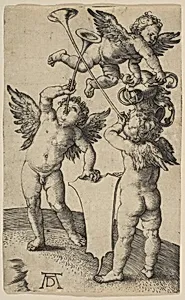
Three Putti with Trumpets
ca. 1500
Medium
Engraving
Dimensions
Sheet: 4 1/2 × 2 13/16 in. (11.4 × 7.2 cm)
Classification
Prints
Department
Drawings and Prints
Museum
Metropolitan Museum of Art, New York, NY
Credit
Bequest of Alexandrine Sinsheimer, 1958
Accession Number
59.534.2
Rights
Public Domain
Tags
Art Historical Context
Albrecht Dürer’s charming engraving *Three Putti with Trump*, created around 1500,ifies the German artist’s mastery of printmaking at the dawn of the Northern Renaissance. leading figure of this movement, Dürer engraving into a sophisticated art form capable of extraordinary detail and emotional nuance. This intimate work, just over four inches tall, rewards close viewing with its lively yet meticulously rendered figures. The print shows three plump, winged putti—cherubic infants frequently used in Renaissance art to evoke innocence, playfulness, or divine presence—holding or sounding trumpets. Such motifs often served decorative or allegorical purposes, suggesting celebration or announcement. Dürer’s sure command of the burin captures the children’s rounded forms, swirling drapery, and energetic poses with remarkable vitality, reflecting his deep study of both Northern observation and Italian classicism. As an engraving, the image could be printed in multiple impressions, helping spread Dürer’s inventive designs throughout Europe and influencing generations of artists. Now in the Metropolitan Museum of Art, this small sheet remains a delightful example of the artist’s technical brilliance and imaginative spirit.
About the Artist
Albrecht Dürer · 1471–1528
Albrecht Dürer (1471–1528) stands as the preeminent figure of the Northern Renaissance and arguably the most influential artist in the history of printmaking. Born in Nuremberg on May 21, 1471, and dying in the same city on April 6, 1528, Dürer revolutionized the status of the artist in Northern Europe, transforming printmaking from a commercial craft into an independent fine art and establishing ...