
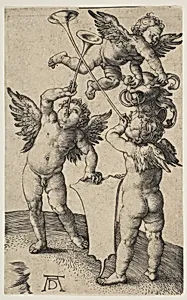
Three Putti with Trumpets
ca. 1500
Medium
Engraving
Dimensions
Sheet: 4 7/16 × 2 3/4 in. (11.3 × 7 cm)
Classification
Prints
Department
Drawings and Prints
Museum
Metropolitan Museum of Art, New York, NY
Credit
George Khuner Collection, Bequest of Marianne Khuner, 1984
Accession Number
1984.1201.17
Rights
Public Domain
Tags
Art Historical Context
Albrecht Dürer's *Three Putti with Trump*, created around 1500, is a delightful engraving that captures the playful spirit of Renaissance putti—chubby, winged infant angels symbolizing joy and divine mischief. Measuring just 4 7/16 × 2 3/4 inches, this intimate print showcases Dürer's mastery of the engraving medium, where he incised fine lines into a copper plate to produce rich, detailed impressions. As a leading figure of the Northern Renaissance, Dürer elevated printmaking from mere reproduction to high art, making works like this accessible to collectors across Europe. The image likely served as a decorative motif, evoking themes of music and celebration through the putti's enthusiastic trumpet blasts. Dürer's technique shines in the subtle textures—from the angels' curly hair and feathery wings to the gleaming instruments—achieved with extraordinary precision on such a tiny scale. Produced during Dürer's prolific early career in Nuremberg, it reflects the era's fascination with classical antiquity and humanism, blending whimsy with technical virtuosity. Today, housed in the Metropolitan Museum of Art's George Khuner Collection, this engraving highlights Dürer's enduring influence on graphic arts, inviting visitors to marvel at how a small sheet can trumpet the Renaissance's exuberant creativity.
About the Artist
Albrecht Dürer · 1471–1528
Albrecht Dürer (1471–1528) stands as the preeminent figure of the Northern Renaissance and arguably the most influential artist in the history of printmaking. Born in Nuremberg on May 21, 1471, and dying in the same city on April 6, 1528, Dürer revolutionized the status of the artist in Northern Europe, transforming printmaking from a commercial craft into an independent fine art and establishing ...