
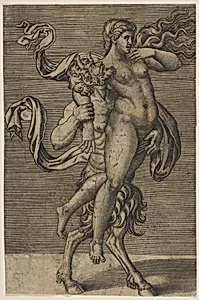
Satyr carrying a nymph restraining her right arm
ca. 1515–27
Medium
Engraving
Dimensions
Sheet (Trimmed): 6 3/4 × 4 7/16 in. (17.1 × 11.2 cm)
Classification
Prints
Department
Drawings and Prints
Museum
Metropolitan Museum of Art, New York, NY
Credit
The Elisha Whittelsey Collection, The Elisha Whittelsey Fund, 1950
Accession Number
50.559.6
Rights
Public Domain
Tags
Art Historical Context
In the spirited world of Renaissance mythology, *Satyr Carrying a Nymph Restraining Her Right Arm* captures a playful yet charged encounter between a lusty satyr—half-man, half-goat—and a resisting nymph. Created around 1515–27 by Romano, a brilliant pupil of Raphael who pioneered Mannerist exaggeration, and engraved by Marco Dente, this intimate engraving (6 3/4 × 4 7/16 in.) depicts the satyr hoisting the nymph over his shoulder amid her feigned protest, evoking ancient Greek tales of woodland desire and pursuit. Engravings like this were revolutionary printmaking techniques, where artists incised fine lines into copper plates, inking them to produce detailed, reproducible images. Dente, a skilled reproductive engraver, likely translated Romano's dynamic design, allowing elite Mannerist compositions to reach wider audiences across Europe. Housed in the Metropolitan Museum of Art's Drawings and Prints department (Elisha Whittelsey Collection, 1950), it exemplifies how 16th-century Italian artists blended classical antiquity with erotic vitality. This work's cultural allure lies in its blend of humor and sensuality, reflecting Renaissance fascination with pagan myths amid Catholic restraint. A window into the era's artistic ingenuity, it invites viewers to ponder the timeless dance of pursuit and resistance.
About the Artist
Giulio Romano|Marco Dente · 1499–1546
Giulio Romano (c. 1499–1546) was the most gifted pupil of Raphael and one of the founding figures of Mannerism, the style that succeeded the High Renaissance in Italy. Born Giulio Pippi in Rome, he entered Raphael's workshop as a boy and proved so talented that by the time of Raphael's death in 1520 he was effectively running the studio and overseeing the completion of major unfinished commissions...