
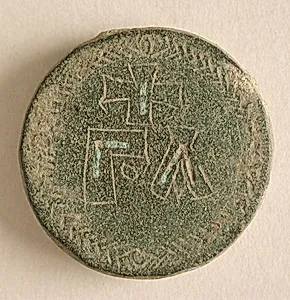
Three Round Copper-Alloy Balance Weights with Crosses
Unknown Artist
8th–9th century
Medium
Copper alloy
Dimensions
1/4 × 1 in., 1oz. (0.6 × 2.6 cm, 27g)
Classification
Metalwork-Copper alloy
Culture
Byzantine
Department
Medieval Art
Museum
Metropolitan Museum of Art, New York, NY
Credit
Purchase, Christopher C. Grisanti and Suzanne P. Fawbush, and Alastair B. Martin Gifts, 2002
Accession Number
2002.213.4
Rights
Public Domain
Art Historical Context
These three small, round copper-alloy balance, each about the size of a modern coin, hail from the Byzantine Empire of the 8th–9th century. Adorned with incised crosses on their surfaces, they served a practical purpose in daily trade and commerce, ensuring fair measurements in bustling markets from Constantinople to provincial outposts. Crafted from durable copper alloy—a common medium for Byzantine metalwork—their modest dimensions (roughly 1/4 × 1 inch, 1 oz. each) highlight the ingenuity of everyday artisans who combined functionality with symbolic design. In the medieval Byzantine world, where Christianity permeated all aspects of life, the crosses on these weights were more than decoration; they invoked divine protection and authenticity, blending faith with economic necessity. Such objects reveal the empire's sophisticated trade networks, linking East and West, and underscore the role of metalwork in preserving cultural identity amid political turmoil like the Iconoclastic Controversies. Today, housed in The Metropolitan Museum of Art's Medieval Art department, these unassuming weights offer a tangible glimpse into Byzantine life—proof that even the humblest tools carried profound artistic and spiritual weight.