
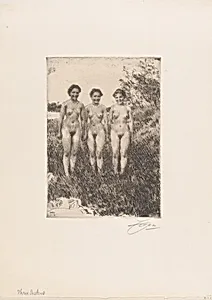
Three Sisters
1913
Medium
Etching; third state of three
Dimensions
Plate: 9 3/4 in. × 7 in. (24.8 × 17.8 cm) Sheet: 17 15/16 × 13 3/16 in. (45.5 × 33.5 cm)
Classification
Prints
Department
Drawings and Prints
Museum
Metropolitan Museum of Art, New York, NY
Credit
Harris Brisbane Dick Fund, 1917
Accession Number
17.3.684
Rights
Public Domain
Tags
Art Historical Context
Anders Zorn's *Three Sisters* (1913) is a captivating etching from the Swedish artist's mature period, showcasing his unparalleled mastery of printmaking. Created as the third and final state of three, this intimate work measures 9 3/4 × 7 inches on the plate, inviting viewers into a delicate interplay of light and shadow. Housed in the Metropolitan Museum of Art's Drawings and Prints department—acquired through the Harris Brisbane Dick Fund in 1917—it exemplifies Zorn's fascination with the female nude, a recurring theme in his oeuvre that celebrated the natural beauty of the human form. Zorn, a leading figure in late 19th- and early 20th-century European art, was renowned for his virtuoso etching technique, which rivaled painting in its luminosity and texture. Using aquatint and drypoint, he achieved subtle tonal gradations and velvety surfaces, capturing the softness of skin and atmospheric depth with remarkable precision. The "third state" indicates the most refined version, where Zorn burnished and reworked the plate for heightened expressiveness. This print not only highlights Zorn's technical innovation but also reflects early 20th-century artistic shifts toward personal, sensual depictions of women, bridging Realism and Impressionism. A gem for print enthusiasts, *Three Sisters* invites contemplation of vulnerability and grace in its nude figures.
About the Artist
Anders Zorn · 1860–1920
Anders Zorn (1860–1920), one of Sweden's most celebrated artists, was born on February 18 in Utmeland near Mora in Dalarna, and raised on his maternal grandparents' farm in the nearby hamlet of Yvraden. Displaying prodigious talent from a young age, he attended school in Mora Strand until age twelve, followed by secondary grammar school in Enköping, where he excelled in drawing people and horses. ...