
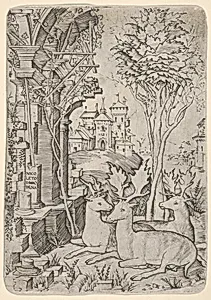
Three Stags, sitting in the ground, buildings in background
ca. 1500–1510
Medium
Engraving
Dimensions
sheet: 5 11/16 x 4 1/8 in. (14.5 x 10.5 cm)
Classification
Prints
Department
Drawings and Prints
Museum
Metropolitan Museum of Art, New York, NY
Credit
Harris Brisbane Dick Fund, 1927
Accession Number
27.20.1
Rights
Public Domain
Tags
Art Historical Context
In the early 16th century, engraver Nicoletto da crafted *Three Stags, Sitting on the Ground, Buildings in*, around 1500–1510. This delicate engraving, measuring just 5 11/16 x 4 1/8 inches, exemplifies the Northern Italian Renaissance's mastery of printmaking. Nicoletto, active in Modena and Ferrara, inspiration from masters like Andrea Mantegna, producing intricate works that blended natural observation with architectural elements. The composition captures three stately deer resting amid trees, with distant buildings evoking a harmonious rural landscape. Engraving's intaglio technique—incising fine lines into a copper plate for inking and printing—allowed for remarkable precision and tonal depth in such a compact format. This method made high-quality images affordable and reproducible, democratizing art beyond paintings for collectors and scholars. Housed in the Metropolitan Museum of Art's Drawings and Prints department (Harris Brisbane Dick Fund, 1927), this print highlights the era's fascination with wildlife and idealized vistas, bridging nature and human presence in a serene, evocative scene. A gem for visitors appreciating Renaissance innovation!
About the Artist
Nicoletto da Modena · 1500–1520
Nicoletto da Modena was an Italian engraver active in the late fifteenth and early sixteenth centuries, one of the most prolific and stylistically eclectic printmakers of the early Italian Renaissance. The details of his biography remain uncertain — his precise birth and death dates are unknown, and he is identified primarily through the body of prints that bear his name or monogram. He appears to...