
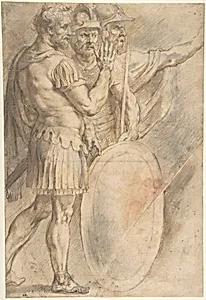
Three Warriors after Raphael
Medium
Pen and brown ink, brush and brown wash, over black and red chalk, light brown and gray oil paint
Dimensions
14 5/8 x 9 13/16 in. (37.2 x 24.9 cm)
Classification
Drawings
Department
Drawings and Prints
Museum
Metropolitan Museum of Art, New York, NY
Credit
Rogers Fund, 1967
Accession Number
67.98
Rights
Public Domain
Tags
Art Historical Context
This intriguing drawing, titled *Three Warriors after Raphael*, captures the enduring influence of Renaissance master Raffaello Sanzio (Raphael) through later interpretations. Created with pen and brown ink, brush and brown wash over black and red chalk, and even touches of oil paint, the work depicts three armored soldiers bearing shields in a dynamic grouping. Attributed in part to the Flemish Baroque master Peter Paul Rubens, alongside an anonymous 16th-century Italian hand, it exemplifies the collaborative and iterative nature of artistic study across centuries. Such copies played a vital role in artistic training and dissemination of ideas. Raphael’s original compositions, often from frescoes or designs, inspired generations of artists who reproduced them to absorb ideal proportions, movement, and classical themes. Here, the layered media—combining delicate chalk underdrawing with bolder ink and wash—highlights both the precision of Renaissance draftsmanship and the expressive energy later added by Rubens. Housed in the Metropolitan Museum of Art’s Department of Drawings and Prints, this sheet (measuring about 14 5/8 by 9 13/16 inches) offers visitors a glimpse into the transmission of artistic knowledge from the High Renaissance into the Baroque era. Its presence in the collection underscores the museum’s role in preserving these vital links between masters and their admirers.
About the Artist
Peter Paul Rubens|Anonymous, Italian, 16th century|Raphael (Raffaello Sanzio or Santi) · 1577–1640
Peter Paul Rubens (1577-1640) stands as the most influential artist of the Flemish Baroque tradition and the greatest exponent of Baroque painting's dynamism, vitality, and sensuous exuberance. Born in Siegen, Westphalia, and raised in Antwerp, Rubens received a humanist education studying Latin and classical literature before pursuing artistic training under three masters: Tobias Verhaecht, Adam ...