
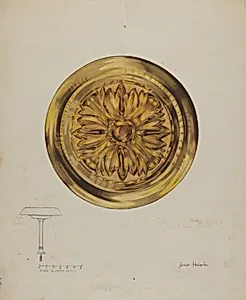
Tie-back
c. 1937
Medium
watercolor, graphite, and pen and ink on paperboard
Dimensions
overall: 28 x 23 cm (11 x 9 1/16 in.)
Classification
Index of American Design
Department
CG-W
Museum
National Gallery of Art, Washington, D.C.
Credit
Index of American Design
Accession Number
1943.8.15099
Rights
Public Domain
Art Historical Context
**Tie-back** by Grace Halpin, created around 1937, captures the elegant simplicity of an everyday American decorative object—a curtain tie-back—through meticulous mixed-media techniques. Rendered in watercolor, graphite, and pen and ink on paperboard, this 28 x 23 cm work exemplifies the precision of the Index of American Design, a Federal Art Project under the Works Progress Administration (WPA). Launched in 1935 amid the Great Depression, the Index employed artists like Halpin to document the nation's folk, craft, and popular arts, producing over 15,000 detailed illustrations to celebrate and preserve indigenous creativity before it faded from modern life. Halpin's rendering highlights the tie-back's graceful form, likely showcasing metalwork or textile elements typical of early 20th-century American homes. The combination of vibrant watercolor washes for color and texture, fine graphite shading for depth, and intricate pen lines for outlines creates a lifelike study that bridges art and documentation. This approach not only records the object's functionality but elevates it as a testament to American ingenuity and craftsmanship. Housed in the National Gallery of Art's collection, **Tie-back** reflects the Index's cultural mission: to foster national pride in everyday design during economic hardship. Today, it invites visitors to appreciate how humble household items embody the artistry of America's past.
About the Artist
Grace Halpin · 1909–1978
**Grace Halpin (1909–1978)** was an American artist best known for her meticulous contributions to the Index of American Design, a Federal Art Project under the Works Progress Administration (WPA) during the 1930s and 1940s. This ambitious initiative commissioned artists to create detailed renderings of everyday American folk and decorative arts, preserving cultural artifacts through watercolor an...