
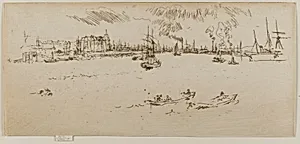
Tilbury
Classification
Department
Smithsonian Collection
Museum
Smithsonian American Art Museum
Credit
Gift of Charles Lang Freer
Accession Number
F1888.10
Rights
Public Domain
Tags
About this artwork
Whistler etchings are identified by "G" numbers as assigned in "James McNeill Whistler: The Etchings, a catalogue raisonne," by Margaret F. McDonald, Grischka Petri, Meg Hausberg, and Joanna Meacock (University of Glasgow, 2012), http://etchings.arts.gla.ac.uk. This print is G312 state 2 of 3.
Art Historical Context
James McNeill Whistler’s 1887 etching *Tilbury* captures a quiet riverside scene along the Thames estuary, where boats and industrial activity meet open water. Born in the United States but long resident in Europe, Whistler was celebrated for his mastery of printmaking, producing atmospheric views that blend precise observation with a sense of fleeting light and space. This work belongs to his later series of Thames subjects, reflecting both his fascination with modern ports and his refined approach to composition. Identified as G312, state 2 of 3, in the definitive catalogue of Whistler’s etchings, the print demonstrates the artist’s careful attention to the medium’s possibilities. Etching allowed him to create delicate lines and subtle tonal shifts that evoke the misty atmosphere of the river. The presence of a boat in the composition underscores Whistler’s interest in maritime subjects during this period. *Tilbury* entered the Smithsonian American Art Museum through the generosity of Charles Lang Freer, whose renowned collection helped preserve many of Whistler’s finest impressions for public appreciation. The print remains a compelling example of late-nineteenth-century American art’s dialogue with European traditions.