
Tile
Unknown Artist
first quarter 18th century
Medium
Composite body; underglaze painted in cobalt
Dimensions
H. 9 15/16 in. (25.2 cm) W. 5 5/16 in. (13.5 cm)
Classification
Ceramics-Tiles
Department
Islamic Art
Museum
Metropolitan Museum of Art, New York, NY
Credit
Gift of Dr. and Mrs. Sidney A. Charlat, in memory of Richard Ettinghausen, 1991
Accession Number
1991.224.2
Rights
Public Domain
Art Historical Context
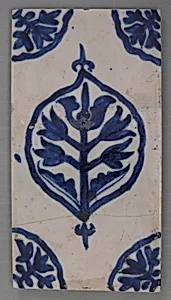
This elegant tile, crafted by an unknown artist in the quarter of the 18 century, exemplifies the refined ceramic traditions of the Islamic world. Hailing from the Metropolitan Museum of Art's Islamic Art, it measures 9 15/16 by 5 5/16 inches and was generously gifted by Dr. and Mrs. Sidney A.lat in memory of Richardinghausen in 1991. Such tiles were integral to architectural splendor, adorning mosques, palaces, public baths across Persia (modern Iran), the Ottoman Empire, and beyond, where they provided both decoration and practical protection against harsh climates. Made from a composite body—likely a stonepaste or fritware mixture that mimicked Chinese porcelain—the tile features underglaze painting in cobalt blue, a technique perfected by Islamic potters centuries earlier. The cobalt oxide pigment is applied directly to the unfired clay, then covered with a transparent glaze and fired at high temperatures, yielding vibrant, durable colors that resist fading. This method, adopted from 13th-century Iran, allowed for intricate floral, geometric, or calligraphic designs symbolizing paradise gardens and divine order. As a testament to Islamic artisanship, this tile highlights a golden era of technical innovation and aesthetic harmony, blending functionality with spiritual beauty. Visitors can appreciate how such modest objects transformed entire spaces into shimmering mosaics of cultural pride.