
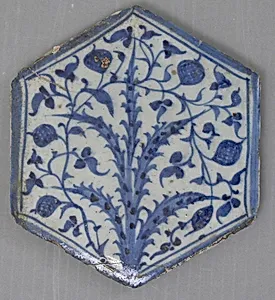
Hexagonal Tile
Unknown Artist
15th century
Medium
Stonepaste; underglaze painted
Classification
Ceramics-Tiles
Department
Islamic Art
Museum
Metropolitan Museum of Art, New York, NY
Credit
Rogers Fund, 1967
Accession Number
67.69.3
Rights
Public Domain
Art Historical Context
This exquisite hexagonal tile, crafted in the 15th by an unknown artist, exemplifies the masterful ceramics of Islamic art. Produced during a golden age of architectural splendor—spanning regions like Persia, Syria, and Egypt under Timurid or Mamluk patronage—such tiles adorned the walls of mosques, madrasas, and palaces Their geometric shape allowed seamless tessellation, creating vast, hypnotic patterns that evoked infinity and divine order, a hallmark of Islamic traditions avoiding figural representation. Made from stonepaste—a fine, vitreous ceramic body developed by Islamic potters to rival Chinese porcelain—the tile features underglaze painting. Pigments were applied directly to the unfired body before a transparent glaze and high-temperature firing, ensuring vibrant, durable colors that withstand centuries. This technique, perfected in the medieval Islamic world, highlighted motifs like arabesques, stars, or calligraphy, blending artistry with engineering. Acquired through the Rogers Fund in 1967, this tile now graces the Metropolitan Museum of Art's Islamic Art collection. It invites us to marvel at the anonymous craftsperson's skill, reminding visitors of how everyday materials transformed sacred spaces into visual symphonies.