
Tile from a Mihrab
Unknown Artist
dated A.H. 722/ 1322–23 CE
Medium
Stonepaste; modeled, painted under transparent glaze
Dimensions
H. 27 3/8 in. (69.5 cm) W. 26 in. (66 cm) Wt. 74 lbs. (33.6 kg)
Classification
Ceramics-Tiles
Department
Islamic Art
Museum
Metropolitan Museum of Art, New York, NY
Credit
Gift of William Mandel, 1983
Accession Number
1983.345
Rights
Public Domain
Tags
Art Historical Context
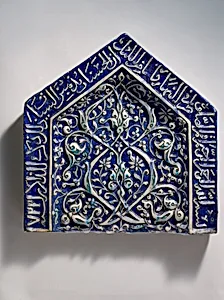
This stunning tile, hailing from a *mihrab*—the sacred prayer niche in a mosque that points toward Mecca—dates to A.H. 722 (1322–23 CE), a golden age of Islamic art under the Ilkhanid dynasty in Persia. Crafted by an unknown artist it exemplifies the architectural splendor of medieval mosques, where vibrant tiles adorned walls to inspire devotion and awe. Measuring over two feet square and weighing a hefty 74 pounds, piece was likely part of a larger mosaic, its monumental scale underscoring the grandeur of religious spaces. Made of stonepaste (a fine fritware body prized for its white color and ability to hold intricate designs), the tile was modeled in relief, then painted under a transparent glaze. This underglaze technique, flourishing in 14th-century Iran and Syria, allowed durable, luminous colors to shine through, often featuring Arabic calligraphy and floral motifs symbolizing paradise. The Arabic tag hints at inscriptions invoking faith, blending artistry with spirituality. Today, gifted to the Metropolitan Museum of Art in 1983, this tile invites us to marvel at Islamic ceramic innovation—how everyday clay became eternal poetry on mosque walls, bridging the divine and the human.