
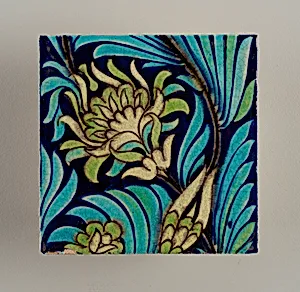
Tile
ca. 1888–98
Classification
tiles
Department
Smithsonian Collection
Museum
Smithsonian American Art Museum
Credit
Museum purchase through gift of Georgiana L. McClellan
Accession Number
1953-104-4
Rights
Public Domain
About this artwork
Research in Progress
Art Historical Context
This exquisite tile, created by British artist and ceramicist William Frend Morgan around 1888–98, the revival of decorative arts during the Arts and Crafts movement De Morgan (1839–1917), initially a Pre-Raphael painter, turned to ceramics in the 1870s, founding studios in London and later Fulham where he produced thousands of handcrafted tiles. Influenced by medieval Persian and Hispano-Moresque pottery, his work emphasized bold, flowing designs of mythical creatures, flora, and fauna, rendered in rich underglaze colors and sometimes iridescent luster glazes—a technique he pioneered in Britain. Though the specific medium details are under research, De Morgan's tiles were typically earthenware, fired multiple times to achieve their jewel-like depth and durability. These pieces were not mere ornaments but integral to Victorian interiors, adorning fireplaces, panels, and furniture for clients like William Morris. This example, acquired by the Smithsonian American Art Museum through a gift from Georgiana L. McClellan, highlights the transatlantic appeal of British design in American collections. De Morgan's innovations bridged historicism and modernism, influencing later Art Nouveau artists. Visitors can appreciate how this tile captures a moment when craftsmanship resisted industrialization, inviting us to trace the intricate patterns that once warmed Edwardian homes.