
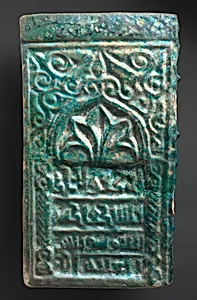
Tile with Niche Design
Unknown Artist
12th century
Medium
Stonepaste; molded, glazed in transparent turquoise
Dimensions
H. 16 3/4 in. (42.5 cm) W. 9 3/4 in. (24.8 cm) D. 1 in. (2.5 cm)
Classification
Ceramics-Tiles
Department
Islamic Art
Museum
Metropolitan Museum of Art, New York, NY
Credit
Theodore M. Davis Collection, Bequest of Theodore M. Davis, 1915
Accession Number
30.95.184
Rights
Public Domain
Art Historical Context
This exquisite *Tile with Niche Design*, crafted by an unknown artist in the12th century, exemplifies pinnacle of Islamic ceramic artistry. Made from stonepaste—a composite of quartz, clay, and frit that allowed artisans to create a fine, porcelain-like body—this molded tile features a graceful niche motif, likely evoking the architectural mihrab, or prayer niche, found in mosques. Its transparent turquoise glaze imparts a luminous, jewel-like quality, a hallmark of medieval Islamic potters who mastered vibrant, durable finishes through high-temperature firing techniques. Hailing from the Islamic world during a golden age of innovation under dynasties like the Seljuks, this tile would have adorned the walls of palaces, mosques, or madrasas, transforming interiors into shimmering spaces of devotion and beauty. The niche design, with its recessed arch and subtle molding, showcases advanced mold-making skills, enabling mass production while retaining intricate detail. At 16 3/4 inches high, it hints at its role in larger decorative panels that unified architectural surfaces. Today, this treasure from the Theodore M. Davis Collection graces the Metropolitan Museum of Art's Islamic Art department, inviting us to appreciate how 12th-century craftsmen blended technical prowess with spiritual symbolism, their turquoise glow enduring across centuries.