
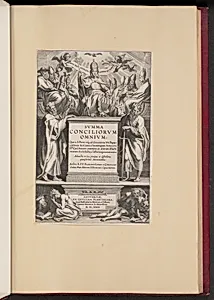
Title Page for F. Longo a Coriolano's "Svmma Conciliorvm Omnivm"
Medium
engraving on laid paper
Classification
Department
CG-E
Museum
National Gallery of Art, Washington, D.C.
Credit
William B. O'Neal Fund
Accession Number
1996.78.6
Rights
Public Domain
Art Historical Context
Welcome to the National Gallery of Art, where we spotlight this exquisite 1623 engraving: the *Title Page for F. Longo a Coriolano's "Svmma Conciliorvm Omnivm"*. Crafted by master engraver Cornelis Galle I after a design by the illustrious Flemish Baroque artist Sir Peter Paul Rubens, this print served as the grand frontispiece for a scholarly compendium on ecumenical councils—a vital theological and legal text of the Counter-Reformation era. Rubens, at the height of his career, infused the composition with his signature dynamism, likely featuring allegorical figures symbolizing wisdom, authority, and divine order to elevate the book's prestige. Galle's meticulous engraving technique brilliantly captures Rubens' bold contrasts and fluid forms on laid paper, a period staple prized for its texture and durability. This collaboration exemplifies the Baroque printmaking revolution, where painters like Rubens partnered with engravers to widely disseminate their visions across Europe, making high art accessible beyond elite patrons. Produced amid religious fervor post-Trent Council, the image underscores the era's blend of erudition and visual splendor. Acquired through the William B. O'Neal Fund (Department CG-E), this print (Classification: Print) invites you to ponder how intricate reproductive prints fueled cultural exchange in the 17th century. A testament to artistic synergy! (198 words)
About the Artist
Cornelis Galle I after Sir Peter Paul Rubens
Cornelis Galle I, born in 1576 in Antwerp as the younger son of the renowned engraver and publisher Philip Galle, received his foundational training under his father, mastering the meticulous techniques of line engraving in the family workshop. Following this apprenticeship, Galle journeyed to Italy around 1597, residing in Siena, Rome, and Genoa until approximately 1603. There, he studied works b...