
Title Page for Stephanus Simonini, Silvae Urbaninae
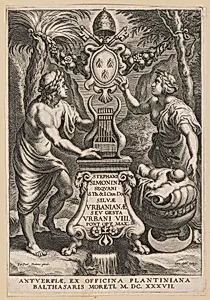
Medium
engraving on laid paper
Classification
Department
CG-E
Museum
National Gallery of Art, Washington, D.C.
Credit
William B. O'Neal Fund
Accession Number
1996.78.62
Rights
Public Domain
Art Historical Context
Welcome to the National Gallery of, where we spotlight *Title Page for Stephanus Simonini Silvae Urbaninae*1637), an exquisite engraving on laid paper by Cornelis I after a design by Sir Peter Paul Rubens. This print served as the grand frontispiece for a book of Latin poems by Stephanus Simon, likely celebrating pastoral or urban themes in the "Silvae Urban" tradition—evoking wooded groves amid city life, a nod to classical Roman poetry. Rubens, the preeminent Flemish Baroque master, was renowned for his dynamic compositions, rich textures, and theatrical energy, hallmarks of the Baroque style that emphasized movement and grandeur. Galle I, a skilled Antwerp engraver and frequent collaborator, masterfully translated Rubens' oil sketch or drawing into intricate lines, capturing the artist's exuberant flourishes. Created in 1637, amid the Dutch Golden Age's print boom, this work exemplifies reproductive printmaking, which made elite designs accessible to scholars, collectors, and the growing middle class across Europe. Engraving's precision on laid paper—characterized by its visible chain lines—allowed for fine details like swirling foliage, allegorical figures, and architectural motifs, blending Rubens' vitality with Galle's technical virtuosity. Acquired through the William B. O'Neal Fund (Department CG-E), this print highlights the era's cultural fusion of literature, nature, and artistry, inviting visitors to appreciate how Baroque innovation bridged painting and print.
About the Artist
Cornelis Galle I after Sir Peter Paul Rubens
Cornelis Galle I, born in 1576 in Antwerp as the younger son of the renowned engraver and publisher Philip Galle, received his foundational training under his father, mastering the meticulous techniques of line engraving in the family workshop. Following this apprenticeship, Galle journeyed to Italy around 1597, residing in Siena, Rome, and Genoa until approximately 1603. There, he studied works b...