
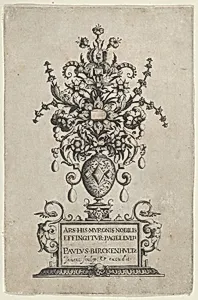
Title Page, from Ars His Myronis Nobilis Effingitus Pagellulis
ca. 1600
Medium
Engraving
Dimensions
Sheet: 5 1/2 × 3 5/8 in. (13.9 × 9.2 cm)
Classification
Prints|Ornament & Architecture
Department
Drawings and Prints
Museum
Metropolitan Museum of Art, New York, NY
Credit
Harris Brisbane Dick Fund, 1923
Accession Number
23.105.1
Rights
Public Domain
Tags
Art Historical Context
Welcome to the Metropolitan Museum of Art's and Prints collection, where you'll find this delicate engraving: *Title Page, from Ars His Myronisobilis Effingitusellulis* by Paul Birckenh, created around 1600. Measuring just 5½ × 3⅝ inches, this intimate sheet exemplifies the precision of Renaissance-era printmaking. Engraving, an intaglio technique where artists incise designs into metal plates with a burin, allowed for intricate details that could be reproduced widely—perfect for disseminating artistic ideas in an age before photography. As a title page from what appears to be a publication celebrating the noble works of the ancient Greek sculptor Myron (famed for dynamic bronzes like the *Discobolus*), this print blends classical reverence with contemporary ornament. Classified under Prints: Ornament & Architecture, it features motifs of flowers and vases, hallmarks of late Renaissance decorative arts. These elements reflect the era's fascination with *grotesques* and *strappwork*—elaborate, scrolling designs inspired by antiquity, popular in architecture, metalwork, and book illustration. Books like this served as pattern sources for craftsmen across Europe, bridging ancient ideals with the opulent tastes of the early Baroque. Birckenhultz's fine lines capture a sense of elegance and abundance, inviting viewers to appreciate how small-scale prints fueled the creative explosion of the 17th century. A gift from the Harris Brisbane Dick Fund in 1923, it reminds us of printmaking's role in democratizing art.
About the Artist
Paul Birckenhultz · 1561–1639
Paul Birckenhultz (1561–1634), also known as Paul Birckenholtz, was a German goldsmith, engraver, and draftsman born in Aachen. Little is known about his early life or formal training, though he emerged as a skilled artisan in the late Renaissance tradition of ornamental design. By the late 1580s, Birckenhultz had traveled extensively, working in Paris and Rome before settling permanently in Frank...