
Title Page from Imaginary Prisons
1749–50
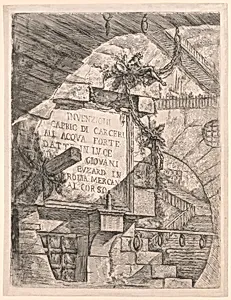
Medium
Etching with engraving and sulphur tint or open bite on ivory laid paper
Dimensions
Image/plate: 54.4 × 41.4 cm (21 7/16 × 16 5/16 in.); Sheet: 57.8 × 44.3 cm (22 13/16 × 17 1/2 in.)
Classification
etching
Department
Prints and Drawings
Museum
Art Institute of Chicago
Accession Number
61179
Rights
Public Domain
Art Historical Context
Giovanni Battista Piranesi, the visionary 18th-century Italian and architect, created the *Title Page from Imaginary Prisons* 1749–50 as the grand introduction to his seminal series *Carceri'invenzione* (Imaginary Prisons). etchings transport viewers into vast, labyrinthine underworlds of crumbling arches, staircases leading nowhere, and shadowy vaults—fantastical architectures that blend Roman antiquity with Piranesi's boundless imagination. Produced during the Enlightenment era, when neoclassicism celebrated rational order, Piranesi's works subverted expectations, evoking a sense of sublime dread and infinite space that influenced Romantic artists like Goya and Escher. This etching, executed with engraving and innovative sulphur tint or open bite on ivory laid paper, exemplifies Piranesi's mastery of printmaking. The sulphur tint technique creates velvety, atmospheric tones, enhancing the dramatic chiaroscuro that makes his prisons feel oppressively alive. Measuring over 54 cm wide, the image's intricate details reward close inspection, showcasing Piranesi's architectural precision honed from his Roman vedute. Housed in the Art Institute of Chicago's Prints and Drawings Department, this title page not only launches one of art history's most iconic series but also captures Piranesi's obsession with decay and human ambition—a timeless meditation on confinement and freedom that continues to captivate visitors.
About the Artist
Giovanni Battista Piranesi · 1720–1778
Giovanni Battista Piranesi (1720–1778) was an Italian printmaker, architect, and antiquarian whose visionary etchings of Rome and imaginary prisons revolutionized architectural representation and profoundly influenced both Neoclassicism and Romanticism. Piranesi stands as one of the most important printmakers of the eighteenth century, fundamentally shaping European perceptions of ancient Rome an...