
Medium
Bound print
Classification
Bound print
Department
Smithsonian Collection
Museum
Smithsonian American Art Museum
Credit
Purchased for the Museum by the Advisory Council
Accession Number
1921-6-282-53
Rights
Public Domain
About this artwork
Research in Progress
Art Historical Context
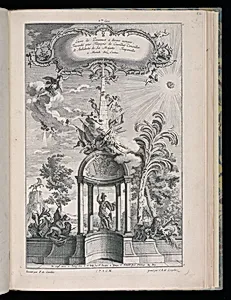
François de Cuvilli the Elder (1695–1768), a Belgian-born architect and designer who thrived in Germany, was a master of the Rococo style during its European heyday. Active primarily in Munich under the Bavarian court, he crafted lavish interiors like the Amalienburg pavilion and the Cuvilliés Theater, blending asymmetry, scrolling motifs, and delicate elegance. His *Title Page* from 1745 exemplifies his role as a tastemaker, serving as the ornate frontispiece to a bound volume of prints—likely a pattern book disseminating his innovative designs for ornamentation, furniture, and architecture. As a bound print, this work highlights the era's revolutionary use of engraving and etching to reproduce intricate details affordably. Rococo prints like these traveled widely, inspiring artisans from Paris to Vienna and fueling the style's spread beyond royal palaces into bourgeois homes. The title page itself would feature sumptuous flourishes—think gilded cartouches, fantastical foliage, and theatrical flourishes—capturing Cuvilliés's flair for fantasy and finesse. Acquired by the Smithsonian American Art Museum through its Advisory Council, this piece reflects ongoing research into 18th-century design dissemination. It invites us to appreciate how one elegant page bridged courts and craftsmen, shaping tastes that still echo in modern interiors.