
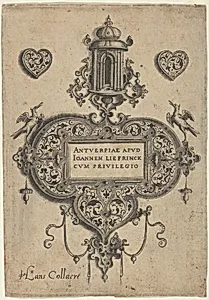
Title Plate, from "Pendant Designs with Architectural Elements and Vegetal-Arabesques"
before 1573
Medium
Engraving and blackwork; first state of three (New Hollstein)
Dimensions
Sheet: 5 13/16 × 4 1/16 in. (14.7 × 10.3 cm)
Classification
Ornament & Architecture|Prints
Department
Drawings and Prints
Museum
Metropolitan Museum of Art, New York, NY
Credit
Harris Brisbane Dick Fund, 1932
Accession Number
32.92.28
Rights
Public Domain
Tags
Art Historical Context
Step into the intricate world of 16th ornamental design with this *Title Plate* from the series *Pendant Designs with Architectural Elements and Vegetal-Arabesques*. Created before 1573 by Flemish engraver Jan Colla I after designs by Hans Liefrinck this small engraving (5 13/16 × 4 1/16 in.) captures the Renaissance fascination with elaborate jewelry motifs. Flourishing vegetal arabesques—swirling plant forms intertwined with architectural cartouches and playful birds—adorn the composition, evoking pendants fit for nobility. Printed in the rare first state of three (as cataloged in *New Hollstein*), the work employs precise engraving combined with blackwork techniques, allowing for rich tonal contrasts and fine details on a modest scale. Such prints were essential tools for goldsmiths and artisans, disseminating sophisticated patterns across workshops in the Netherlands and beyond during the Mannerist era. Housed in the Metropolitan Museum of Art's Drawings and Prints department (Harris Brisbane Dick Fund, 1932), this piece highlights the collaborative artistry of the period, where design and execution merged to inspire opulent decorative arts. A testament to printmaking's role in spreading ornamental innovation, it invites us to appreciate the delicate interplay of nature and architecture in everyday luxury.