
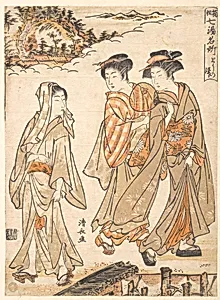
To-no Sawa (Name of one of the hot springs at Hakone)
ca. 1779
Medium
Woodblock print; ink and color on paper
Dimensions
10 x 7 11/32 in. (25.4 x 18.7 cm)
Classification
Prints
Culture & Period
Japan · Edo period (1615–1868)
Department
Asian Art
Museum
Metropolitan Museum of Art, New York, NY
Credit
The Francis Lathrop Collection, Purchase, Frederick C. Hewitt Fund, 1911
Accession Number
JP720
Rights
Public Domain
Tags
Art Historical Context
Torii Kiyonaga's *To-no Sawa*, created around 1779, captures the leisurely allure of Hakone's famous hot springs during Japan's Edo period (16151868). This wood print, a hallmark of ukiyo-e ("pictures of the floating world"), depicts women—likely actresses from the vibrant Kabuki theater scene—enjoying the steamy waters of Tō Sawa, one of Hakone's renowned onsen. Kiyonaga, a master the Torii school, excelled in bijin-ga (images of beautiful women) and yakusha-e (actor portraits), blending elegance with everyday pleasures to reflect urban Japan's fascination with theater, travel, and sensuality. The medium—ink and color on paper, measuring a compact 10 x 7 11/32 inches—highlights the ingenuity of woodblock printing. Artisans used multiple carved cherry wood blocks, each inked in vibrant hues like vermilion and Prussian blue, to produce affordable, mass-reproducible art that democratized beauty for commoners. Kiyonaga's refined lines and subtle shading evoke a dreamlike intimacy, emphasizing the figures' graceful poses amid misty landscapes. Housed in the Metropolitan Museum of Art's Asian Art collection (The Francis Lathrop Collection, 1911), this print offers a window into Edo leisure culture, where hot springs symbolized relaxation and escapism. It celebrates female performers, underscoring women's roles in entertainment, and remains a testament to ukiyo-e's enduring influence on global art.
About the Artist
Torii Kiyonaga · 1752–1815
Torii Kiyonaga, born Sekiguchi Shinsuke in 1752 in Uraga, Sagami Province, was the son of an Edo bookseller who owned tenements near a bustling fish market. At age 14 in 1765, he began his apprenticeship under Torii Kiyomitsu, the third-generation head of the prestigious Torii school of ukiyo-e, renowned for kabuki theater illustrations and signage. Adopted into the Torii family, Kiyonaga succeede...