
Tobacco box
ca. 1760–65
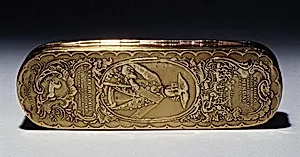
Medium
Brass, copper
Dimensions
1 1/2 × 6 3/4 × 2 in. (3.8 × 17.1 × 5.1 cm)
Classification
Metalwork-Brass
Culture
German, Iserlohn
Department
European Sculpture and Decorative Arts
Museum
Metropolitan Museum of Art, New York, NY
Credit
Gift of Joseph W. Drexel, 1889
Accession Number
89.2.13
Rights
Public Domain
Tags
Art Historical Context
The tobacco box presents an elongated oval form crafted from brass with copper accents, its surface covered in finely engraved decoration. At the center, a medallion shows a rider on horseback within an oval frame, flanked by panels of German inscriptions and bordered by scrolling motifs that include additional figures and horses. The warm golden tone of the metal enhances the crisp lines of the engraving, giving the object a refined yet functional appearance suited to daily use. Created in Iserlohn, Germany, around 1760–65 by Johann Heinrich Giese, this piece belongs to a tradition of engraved brass tobacco boxes popular in eighteenth-century Europe. Giese’s workshop specialized in such metalwork, producing containers that combined practical storage with elaborate pictorial storytelling. The Metropolitan Museum of Art holds this example through the 1889 gift of Joseph W. Drexel. These boxes often served as personal accessories, their engraved scenes reflecting contemporary interests in equestrian subjects and commemorative imagery. Today the work offers visitors a glimpse into the decorative arts of the period, where skilled metalworkers turned everyday objects into small works of art.
About the Artist
Johann Heinrich Giese · 1716–1761
**Johann Heinrich Giese (1716–1761)** was a skilled German engraver and metalworker based in Iserlohn, a town renowned for its brass and copper production in the 18th century. Specializing in decorative tobacco and snuff boxes, Giese became one of the leading figures in this craft during the mid-1700s. His work combined practical utility with intricate stamped designs, often commemorating historic...