
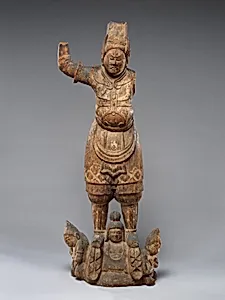
兜跋毘沙門天立像|Tobatsu Bishamonten
Unknown Artist
late 10th–early 11th century
Medium
Zelkova wood with traces of color
Dimensions
H. 49 1/4 in. (125.1 cm)
Classification
Sculpture
Culture & Period
Japan · Heian period (794–1185)
Department
Asian Art
Museum
Metropolitan Museum of Art, New York, NY
Credit
Mary Griggs Burke Collection, Gift of the Mary and Jackson Burke Foundation, 2015
Accession Number
2015.300.253a, b
Rights
Public Domain
Tags
Art Historical Context
This striking wooden sculpture depicts Tobatsu Bishamont, a fierce manifestation of Bishamonten (Vaishravana), one of the Four Heavenly Kings in Buddhist cosmology. As the guardian of the north and protector of the Buddhist dharma, he is often shown trampling a demon underfoot, symbolizing the triumph of enlightenment over ignorance. Carved in the late 10th to early 11th century during Japan's Heian period (7941185)—an era of refined courtly culture and flourishing Buddhism—this statue reflects the period's deep devotion to esoteric Buddhist practices, where such guardian deities were enshrined in temples to ward off evil. Crafted from zelkova wood, a durable hardwood favored for its fine grain and workability, the figure stands an imposing 49¼ inches tall. The artist's masterful carving captures dynamic movement in the deity's stance and flowing robes, with subtle traces of original pigmentation hinting at once-vibrant colors that heightened its spiritual presence. Heian sculptures like this exemplify the shift toward more naturalistic yet idealized forms, blending realism with divine power. Housed in the Metropolitan Museum of Art's Asian Art Department, this rare survivor from the Mary Griggs Burke Collection offers a window into medieval Japan's artistic and religious world, where wood sculpture became a pinnacle of devotional art. Visitors are invited to marvel at its serene ferocity, a testament to enduring Buddhist iconography.