
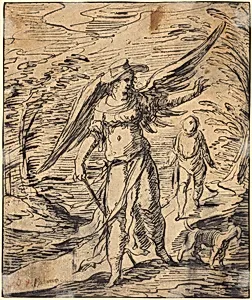
Tobias and the Angel [verso]
c. 1616/1617
Medium
pen and black ink on laid paper
Dimensions
overall: 17.4 x 14.5 cm (6 7/8 x 5 11/16 in.)
Classification
Drawing
Department
CG-E
Museum
National Gallery of Art, Washington, D.C.
Credit
Ailsa Mellon Bruce Fund
Accession Number
1991.127.1.b
Rights
Public Domain
Art Historical Context
Discover the delicate drawing *Tobias and the Angel [verso]* by Hermann Weyer, created around 1616–1617. This intimate work on laid paper, measuring just 17.4 x 14.5 cm, captures a pivotal moment from the biblical Book of Tobit in Apocrypha. Here, the young Tobias journeys with the archangel Raphael (disguised as a companion), who guides him on a quest to retrieve money and heal his father's blindness—a tale of faith, obedience, and divine intervention that resonated deeply in Christian art during the Counter-Reformation era. Weyer's mastery shines in his use of pen and black ink, a favored medium for preliminary sketches and autonomous studies in the early 17th century. The technique allows for fluid, expressive lines that convey motion and narrative drama, typical of Northern European draughtsmen influenced by printmaking traditions. Laid paper, with its visible chain lines from the manufacturing process, was standard for such works, lending authenticity and texture to the piece. Housed in the National Gallery of Art's Department of Drawings (CG-E) through the Ailsa Mellon Bruce Fund, this verso-side drawing highlights Weyer's skill in religious subjects. Its small scale invites close contemplation, offering visitors a window into the devotional art of early modern Europe, where such works served both artistic preparation and personal piety. (198 words)