
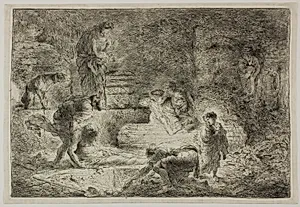
Tobit Burying the Dead
Medium
Etching on paper
Dimensions
Image: 21 × 29.5 cm (8 5/16 × 11 5/8 in.); Plate: 20.7 × 30.1 cm (8 3/16 × 11 7/8 in.); Sheet: 21.3 × 31.2 cm (8 7/16 × 12 5/16 in.)
Classification
etching
Department
Prints and Drawings
Museum
Art Institute of Chicago
Accession Number
33315
Rights
Public Domain
Art Historical Context
**Tobit Burying Dead** is a striking etching by Giovanni Benedetto Cast, created between 1647 and1651. This 17th-century Italian, often called il Grechetto, captures a poignant biblical scene from the Book of Tobit, where pious Jew risks persecution to bury the dead in Nineveh—a testament to faith and compassion amid tyranny. Printed on paper with precise dimensions (image: 21 × 29.5 cm), the work exemplifies Castiglione's mastery in the Baroque era, blending dramatic storytelling with emotional depth. Castiglione, active in Genoa and influenced by Rembrandt's tenebrism, elevated etching beyond mere reproduction into a painterly art form. His technique—using fine, fluid lines and rich tonal contrasts—creates a moody atmosphere of shadow and light, drawing viewers into the solemn ritual. As one of the earliest Italian artists to fully embrace etching, he produced about 70 plates, prized for their immediacy and expressiveness compared to oil paintings. Housed in the Art Institute of Chicago's Prints and Drawings department, this piece highlights etching's democratic appeal: affordable yet sophisticated, it allowed Baroque narratives to reach wider audiences. A gem for visitors, it invites reflection on piety's quiet heroism.
About the Artist
Giovanni Benedetto Castiglione · 1609–1664
Versatile and eclectic artist open to foreign influence which was unusual for an Italian artist of his time. Some of his best-known works are somewhat fantastical. He was court painter at Mantua from 1648. Comment on works: Religious; Landscapes; Animals; Mythology.