
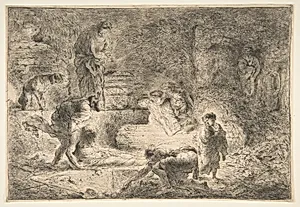
Tobit burying the Dead
Medium
Etching
Dimensions
Sheet: 8 1/16 × 11 3/4 in. (20.4 × 29.8 cm)
Classification
Prints
Department
Drawings and Prints
Museum
Metropolitan Museum of Art, New York, NY
Credit
Gift of Bertina Suida Manning and Robert L. Manning, 1980
Accession Number
1980.1135.2
Rights
Public Domain
Tags
Art Historical Context
In the mid-17th century, Benedetto Castiglione, known as Il Grechetto, created *Tobit Burying the Dead*, a etching capturing a scene from the biblical Book ofit. This apocryphal tale depicts the pious Jew Tobit defying Assyrian laws in Nineveh by burying his slain countrymen at night, an act of faith amid peril. Produced around 1647–51, the work exemplifies Castiglione's mastery during the Italian Baroque era, blending dramatic religious narrative with Genoa's vibrant artistic tradition. As an innovative etcher, Castiglione rivaled contemporaries like Rembrandt in technique, using etching—a process of biting acid into metal plates—to achieve rich, velvety tones and intricate lines. Measuring just 8 1/16 × 11 3/4 inches, this intimate print conveys profound emotion through shadowy figures and dynamic composition, highlighting themes of duty and mortality. Its classification as a print underscores etching's role in democratizing art, allowing wide dissemination of Baroque grandeur. Now housed in the Metropolitan Museum of Art's Drawings and Prints department, gifted by Bertina Suida Manning and Robert L. Manning in 1980, the piece invites visitors to reflect on timeless virtues. Tags like "Men" and "Burials" evoke its solemn focus, making it a gem for exploring 17th-century devotion through masterful printmaking.
About the Artist
Giovanni Benedetto Castiglione (Il Grechetto) · 1609–1664
Giovanni Benedetto Castiglione, known as Il Grechetto, was baptized on March 23, 1609, in Genoa and died on May 5, 1664, in Mantua. Born into a large family, he collaborated closely with his brother Salvatore, an artist who shared his talents, and later taught his son Francesco, whose works were sometimes confused with his own. His parents placed him in the studio of Giovanni Battista Paggi, where...