
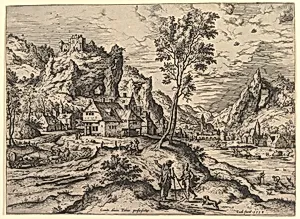
Tobit from Landscapes with Biblical and Mythological Scenes
1558
Medium
Etching
Dimensions
Sheet: 9 1/16 x 12 7/16 in. (23 x 31.6 cm)
Classification
Prints
Department
Drawings and Prints
Museum
Metropolitan Museum of Art, New York, NY
Credit
The Elisha Whittelsey Collection, The Elisha Whittelsey Fund, 1956
Accession Number
56.597.52(7)
Rights
Public Domain
Tags
Art Historical Context
**Tobit from *Landscapes with Biblical andological Scenes*** Hieronymus Cock, a leading Antwerp printmaker of the 16th century created this etching in 1558 as part of his innovative series blending biblical narratives with expansive landscapes. Cock, often called the "father of Netherlandish landscape etching," ran the influential publishing house At the Four Windmills, detailed prints that elevated landscape as a central artistic element rather than mere backdrop. This work draws from the Book of Tobit in the Apocrypha, featuring scene with men amid hills, trees, buildings, and sweeping vistas—hallmarks of the emerging "world landscape" style popularized in the Low Countries. Etching, Cock's preferred medium here, allowed for intricate, fluid lines etched into a copper plate with acid, enabling the fine textures of foliage, architecture, and distant horizons seen in the 9 x 12-inch sheet. This technique democratized art, making complex compositions affordable through multiple impressions. The series reflects the Renaissance fascination with antiquity and scripture, merging moral tales like Tobit's journey of faith and healing with the era's growing appreciation for nature's grandeur. Housed in the Metropolitan Museum of Art's Elisha Whittelsey Collection, this print exemplifies Cock's role in bridging painting and printmaking, influencing later masters like Rembrandt. Visitors will appreciate its harmonious fusion of story and scenery, a window into 16th-century Europe's artistic and spiritual world. (218 words)
About the Artist
Hieronymus Cock · 1510–1570
Hieronymus Cock, born Hieronymus Wellens de Cock in Antwerp in 1518, emerged from a distinguished artistic lineage; his father, Jan Wellens de Cock, and brother, Matthys Cock, were both accomplished painters and draftsmen. Admitted as a master painter to Antwerp's Guild of Saint Luke in 1545, he honed his skills in the vibrant Netherlandish tradition before traveling to Rome from 1546 to 1547, whe...