
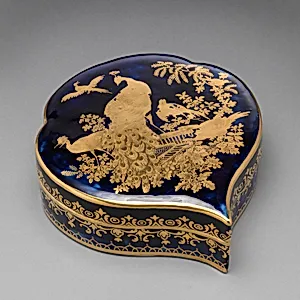
Toilet box containing four smaller boxes
ca. 1761
Medium
Soft-paste porcelain, Mazarin blue ground with gold decoration
Dimensions
Overall (confirmed): 2 1/8 × 6 1/2 × 5 13/16 in. (5.4 × 16.5 × 14.8 cm)
Classification
Ceramics-Porcelain
Culture
British, Chelsea
Department
European Sculpture and Decorative Arts
Museum
Metropolitan Museum of Art, New York, NY
Credit
Gift of Irwin Untermyer, 1964
Accession Number
64.101.499a–j
Rights
Public Domain
Tags
Art Historical Context
Step into the opulent world of 18-century British elegance with this exquisite *Toilet box containing four smaller*, crafted by the renowned Chelsea Porcelain Manuf around 1761. Made of soft-paste porcelain—a pioneering English innovation that mimicked the prized Chinese hard-paste—this compact treasure measures just over 2 inches high and 6½ inches wide. Its rich Mazarin blue ground a deep cobalt hue inspired by French luxury wares, is lavishly accented with intricate gold decoration featuring peacocks and flowers, evoking the playful Rococo style popular among the aristocracy. Chelsea, one of Britain's earliest porcelain factories (founded in the 1740s), reached its artistic zenith in the 1760s during the "Gold Anchor" period, marked by exceptional technical refinement and whimsical designs. Soft-paste porcelain allowed for delicate molding and vibrant enameling, techniques that showcased the factory's mastery in replicating Oriental aesthetics while infusing British flair. These toilet boxes were essential to the elaborate *toilette* rituals of the elite, holding cosmetics, jewelry, or trinkets in nested compartments for intimate vanity use. Today, this piece, a gift to the Metropolitan Museum of Art from Irwin Untermyer in 1964, highlights Chelsea's role in elevating ceramics to high art. Its gilded motifs of strutting peacocks amid blooming flowers symbolize prosperity and beauty, offering a glimpse into Georgian luxury and the era's fascination with exotic refinement.
About the Artist
Chelsea Porcelain Manufactory · 1744–1784
**Chelsea Porcelain Manufactory** The Chelsea Porcelain Manufactory, Britain's pioneering porcelain enterprise, was founded around 1743 in Chelsea, London, by two Huguenot silversmiths: Nicholas Sprimont from Liège and Charles Gouyn. Sprimont, trained in Paris as a goldsmith before immigrating to England, brought his expertise in luxury metalwork to the venture, while Gouyn handled early sales th...