
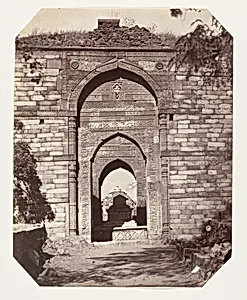
[Tomb at the Qutub Minar, Delhi]
1858–61
Medium
Albumen silver print
Dimensions
Image: 21.2 x 16.6 cm (8 3/8 x 6 9/16 in.) Mount: 33 x 26 cm (13 x 10 1/4 in.)
Classification
Photographs
Department
Photographs
Museum
Metropolitan Museum of Art, New York, NY
Credit
Gilman Collection, Purchase, Cynthia Hazen Polsky Gift, 2005
Accession Number
2005.100.491.1 (62)
Rights
Public Domain
Tags
Art Historical Context
Step into the shadowed elegance of 19th-century India with this albumen silver print, *Tomb at the Qutub Minar, Delhi*, captured between 1858 and 1861. This intimate photograph (21.2 x 16.6 cm image on a larger 33 x 26 cm mount) showcases the intricate arches and timeless architecture of a tomb within the Qutub complex, a UNESCO World Heritage site in Delhi. The Qutub Minar itself, a soaring victory tower from the early Delhi Sultanate (12th–13th centuries), anchors this scene of Indo-Islamic mastery, where domes, iwans, and Quranic calligraphy blend Persian and local influences. Created during the British colonial era, shortly after the 1857 Indian Rebellion, the image reflects a pivotal moment when Western photographers began systematically documenting India's architectural treasures. Albumen silver prints, the era's gold standard for photography, used egg whites to bind light-sensitive silver salts, yielding sharp details, warm tones, and a glossy sheen that vividly preserves stone carvings and geometric patterns otherwise vulnerable to time and decay. Housed in the Metropolitan Museum of Art's Gilman Collection, this work bridges art and history, inviting us to ponder the tomb's serene guardianship amid empires risen and fallen. It's a window to Delhi's layered past, where photography first immortalized such wonders for global audiences.
About the Artist
Unknown
The artist designated as "Unknown" in our virtual museum's collection exemplifies a poignant chapter in art history: creators whose identities have faded into obscurity despite the enduring power of their work. With only one known artwork attributed to them in our holdings, this figure represents countless anonymous hands that shaped visual culture across centuries. Museums worldwide, including th...