
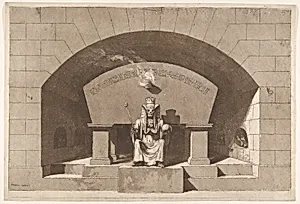
Tomb with Death Enthroned as a Sphinx
ca. 1779–84
Medium
Etching and aquatint, printed in brown ink, ii/ii
Dimensions
Sheet: 13 1/4 x 19 7/16 in. (33.7 x 49.3 cm)
Classification
Prints
Department
Drawings and Prints
Museum
Metropolitan Museum of Art, New York, NY
Credit
Purchase, Janet Lee Kadesky Ruttenberg Fund, in honor of Colta Ives, 2012
Accession Number
2012.189
Rights
Public Domain
Tags
Art Historical Context
In the late 18th century, artist Louis Jean Desprez crafted *Tomb with Death Enthed as a Sphinx*ca. 1779–84), a striking etching and aquatint that embodies the era's fascination with mortality amid the Enlightenment's rationalism and pre-Revolutionary tensions. Desprez, renowned for his neoclassical architectural designs and theatrical scenery, infused this print with dramatic flair, personifying Death as a sphinx perched atop a tomb flanked by skeletons. This macabre motif draws on ancient symbolism—the sphinx evoking riddles of fate—while echoing vanitas traditions that reminded viewers of life's transience. Printed in warm brown ink on a generous sheet (13 1/4 x 19 7/16 in.), the work showcases Desprez's mastery of etching for precise lines and aquatint for subtle tonal gradations, creating shadowy depths and eerie atmospheres rare in prints of the time. As the second state (ii/ii), it represents a refined impression, highlighting the medium's evolution toward painterly effects in neoclassical art. Acquired by The Metropolitan Museum of Art in 2012, this piece offers a haunting glimpse into Desprez's visionary style, bridging antiquity with Gothic undertones and inviting reflection on death's enigmatic throne.
About the Artist
Louis Jean Desprez · 1743–1804
Louis Jean Desprez (1743–1804), born in Auxerre to a wig-maker father and widowed mother, began his artistic training as a twelve-year-old apprentice under engraver Charles-Nicolas Cochin in Paris in 1755. He later studied at the Académie royale d'architecture, sponsored by architect Pierre Desmaisons, and became a pupil of Charles de Wailly from 1768 to 1776, embracing neoclassicism inspired by I...