
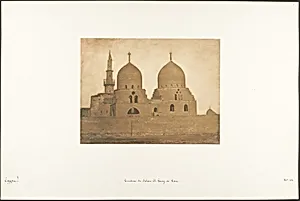
Tombeau du Sultan El-Goury, au Kaire
December 1849–January 1850
Medium
Salted paper print from paper negative
Dimensions
Image: 6 9/16 × 8 11/16 in. (16.6 × 22 cm) Mount: 12 5/16 × 18 11/16 in. (31.2 × 47.5 cm)
Classification
Photographs
Department
Photographs
Museum
Metropolitan Museum of Art, New York, NY
Credit
Gilman Collection, Gift of The Howard Gilman Foundation, 2005
Accession Number
2005.100.376.14
Rights
Public Domain
Tags
Art Historical Context
Step into the sunlit grandeur of 19th-century Cairo with Maxime Du Camp's *Tombeau du Sultan El-Goury, au Kaire*, a salted paper print captured between December 1849 and January 1850. This poignant photograph depicts the ornate tomb of Sultan Al-Ghuri, a Mamluk ruler whose funerary complex exemplifies intricate Islamic architecture with its carved stone facades, domes, and arabesque details. Du Camp, a French writer and pioneering photographer, documented this site during his transformative journey through Egypt alongside Gustave Flaubert, bringing distant wonders to European eyes. Printed from a paper negative using the calotype process—a breakthrough technique invented by William Henry Fox Talbot—this medium allowed for detailed textures and subtle tones on salted paper, marking one of the earliest photographic records of Middle Eastern monuments. At just 6 9/16 × 8 11/16 inches, the image's modest scale belies its monumental subject, inviting viewers to trace the play of light on ancient surfaces. Du Camp's work holds immense historical significance as part of the first major photographic survey of Egypt, fueling 19th-century Orientalism and scholarly interest in Islamic heritage. Housed in The Metropolitan Museum of Art's Gilman Collection, it reminds us how photography bridged worlds, preserving architectural treasures for generations.
About the Artist
Maxime Du Camp · 1822–present
Maxime Du Camp (1822–1894) was a pioneering French photographer and writer whose adventurous spirit and technical innovation bridged literature and visual art during the mid-19th century. Born in Paris on February 8, 1822, to a prosperous family—his father a successful surgeon—Du Camp received a solid bourgeois education at the Collège Bourbon (now Lycée Condorcet), where he cultivated interests i...