
Tonkari (トンコリ)
Unknown Artist
late 19th century
Medium
Wood
Dimensions
L. 30 × W. 3 in. (76.2 × 7.6 cm)
Classification
Chordophone-Lute-plucked-unfretted
Culture
Japanese (Ainu)
Department
Musical Instruments
Museum
Metropolitan Museum of Art, New York, NY
Credit
The Crosby Brown Collection of Musical Instruments, 1889
Accession Number
89.4.133
Rights
Public Domain
Art Historical Context
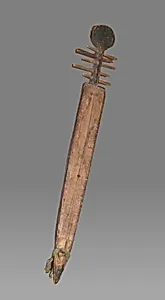
Nestled in the Metropolitan Museum of Art's Crosby Brown Collection of Musical Instruments the *Tonkari* (トンコリ) is a captivating example of late 19th Ainu craftsmanship from Japan. Carved from a single piece of wood measuring 30 inches long and 3 inches wide, slender lute embodies the ingenuity of the Ainu, Japan's indigenous people of Hokkaido and surrounding regions. Its minimalist form—smoothly sculpted with a resonant body and extended neck—highlights the practical artistry of a culture deeply connected to nature and oral traditions. As a chordophone classified as a plucked, unfretted lute, the *Tonkari* features two or three strings traditionally played by plucking with the fingers or a plectrum. In Ainu society, it accompanied epic storytelling, rituals, and songs that preserved myths and histories passed down orally. Acquired in 1889, this instrument offers a window into a pre-industrial era, showcasing woodworking techniques refined over generations without metal frets, emphasizing pure tone and player intuition. Today, the *Tonkari* stands as a testament to Ainu cultural resilience, bridging music and heritage in the museum's vast collection. Visitors can imagine its haunting melodies echoing through northern forests, inviting reflection on indigenous voices in global art.