
Topaza pyra (Fairy Topaz)
1801 to 1825
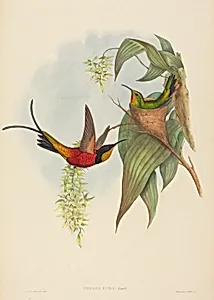
Medium
hand-colored lithograph
Dimensions
sheet: 55.7 × 38.5 cm (21 15/16 × 15 3/16 in.)
Classification
Department
CG-E
Museum
National Gallery of Art, Washington, D.C.
Credit
Gift of Dr. and Mrs. George Benjamin Green
Accession Number
1970.25.6
Rights
Public Domain
Art Historical Context
This hand-colored lithograph, *Topaza pyra (Fairy Topaz)*, captures the shimmering iridescence of a hummingbird species native to South America. Created between 1801 and 1825 by the renowned British ornithologist and artist John Gould in collaboration with H.C. Richter, the print exemplifies the golden age of natural history illustration. Gould’s meticulous studies brought exotic birds to European audiences at a time when global exploration was expanding scientific knowledge. The work’s medium is particularly noteworthy. Lithography, a relatively new printing technique in the early nineteenth century, allowed for fine detail and subtle tonal gradations that were then enhanced by hand-applied watercolor. Measuring roughly 22 by 15 inches, the sheet balances scientific precision with artistic elegance, rendering the bird’s jewel-like plumage against a simple background. Today housed in the National Gallery of Art as a gift from Dr. and Mrs. George Benjamin Green, this print reflects the nineteenth-century fascination with the natural world. Gould’s images helped transform ornithology from a specialist pursuit into a subject of widespread public wonder and appreciation.
About the Artist
John Gould and H.C. Richter
John Gould (1804–1881) and Henry Constantine Richter (1821–1902) formed one of the most productive and celebrated partnerships in the history of natural history illustration. Gould, an English ornithologist and publisher of extraordinary ambition, built a career on the production of lavishly illustrated folio volumes documenting the birds of Britain, Europe, Australia, Asia, and the Americas. Thou...