
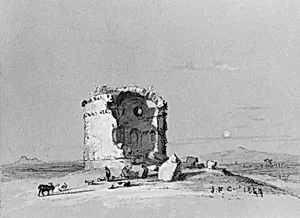
Torre dei Schiavi, The Roman Campagna (from Cropsey Album)
Medium
Graphite, white gouache, and brown and gray ink washes on dark buff wove paper
Dimensions
4 1/8 x 5 11/16 in. (10.5 x 14.4 cm)
Classification
Drawing
Culture
American
Department
The American Wing
Museum
Metropolitan Museum of Art, New York, NY
Credit
Purchase, Charles and Anita Blatt Gift, 1970
Accession Number
1970.9.26 recto
Rights
Public Domain
Tags
About this artwork
This work by american artist Jasper Francis Cropsey exemplifies the artistic achievements of 1853. American artists of this period were establishing distinct visual traditions while engaging with European artistic movements. Created in graphite, white gouache, and brown and gray ink washes on dark buff wove paper, this painting showcases the artist's technical command and aesthetic sensibility. The medium offered particular qualities of color, texture, and luminosity that artists exploited to ac...
Art Historical Context
Jasper Francis Cropsey, prominent American landscape artist associated with the Hudson River School, captured the timeless allure of ancient ruins in *Torre dei Schi, The Roman Campagna (1853). This intimate sketch from his Cropsey Album depicts the iconic dei Schiavi, a cylindrical mausoleum tower amid the vast Roman countryside, evoking the grandeur and melancholy of antiquity. Created during a period when American artists like Cropsey traveled to Europe to study Old World masterpieces, it reflects their ambition to forge a distinct national style while embracing Romantic interests in nature's sublime power and historical decay. Executed in graphite, white gouache, and brown and gray ink washes on dark buff wove paper, the work measures just 4 1/8 x 5 11/16 inches, inviting close contemplation. Cropsey's masterful washes build atmospheric depth and luminosity, with the tinted paper enhancing subtle tonal contrasts and textured effects—techniques that highlight his command of light and shadow in capturing the Campagna's hazy expanse. Housed in The Metropolitan Museum of Art's American Wing, this piece underscores 19th-century American artists' dialogue with European traditions. Acquired through the Charles and Anita Blatt Gift in 1970, it preserves Cropsey's exploratory practice, illuminating how U.S. creators in 1853 blended transatlantic influences to interpret enduring symbols of time and ruin.
About the Artist
Jasper Francis Cropsey · 1823–1900
Jasper Francis Cropsey (1823–1900) was an American landscape painter associated with the Hudson River School, the influential mid-nineteenth-century movement that celebrated the natural grandeur of the American continent in large, luminous canvases. Born on Staten Island, New York, Cropsey initially trained as an architect — a background that gave him a strong sense of spatial structure and formal...