
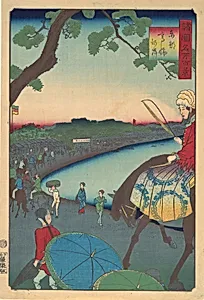
Tōtō Takanawa Kaigen|Foreigners Riding Along the Coast at Takanawa in the Eastern Capital
9th month, 1861
Medium
Woodblock print; ink and color on paper
Dimensions
Image: 14 1/4 x 10 5/8 in. (36.2 x 27 cm)
Classification
Prints
Culture & Period
Japan · Edo period (1615–1868)
Department
Asian Art
Museum
Metropolitan Museum of Art, New York, NY
Credit
Bequest of William S. Lieberman, 2005
Accession Number
2007.49.147
Rights
Public Domain
Tags
Art Historical Context
In this vibrant woodblock print from 1861, Utagawa Hiroshige II captures a striking moment of cultural encounter: foreigners riding horses along the scenic coast at Takanawa a coastal district in Edo (modern-day Tokyo, the "Eastern Capital"). Created during the final years of the Edo period (1615–1868), the artwork depicts men and women on horseback amid lush trees, evoking the novelty and curiosity surrounding Western visitors. Hiroshige II, a to his famous uncle Hiroshige I, masterfully continued the ukiyo-e of "pictures of the floating world," blending precise lines, bold colors, and atmospheric perspective to bring everyday scenes to life. The print's historical significance lies in its reflection of Japan's turbulent opening to the West. Following Commodore Perry's arrival in 1853, treaties allowed foreigners into ports and cities, sparking fascination and unease. Horses, uncommon for ordinary Japanese travel, symbolize this foreign intrusion, while Takanawa's shoreline setting highlights Edo's evolving urban landscape. As a nishiki-e (brocade picture) in ink and color on paper, it showcases the collaborative woodblock process—carvers, printers, and publishers creating layered hues through multiple blocks—for mass appeal. Today, housed in the Metropolitan Museum of Art, this 14¼ × 10⅝-inch gem offers a window into a pivotal era, blending artistic elegance with the dawn of modernization.
About the Artist
Utagawa Hiroshige II · 1826–1869
Utagawa Hiroshige II, born Suzuki Chinpei in 1826, was one of the most accomplished ukiyo-e artists of mid-nineteenth century Japan. He entered the studio of the celebrated landscape master Utagawa Hiroshige I — known for his iconic series "The Fifty-three Stations of the Tokaido" — and proved himself the most talented of the elder artist's few students. So highly regarded was the young pupil that...