
Touch
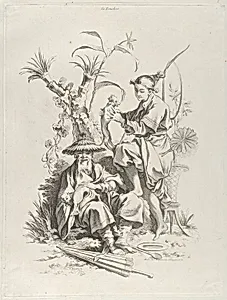
Medium
Etching and engraving
Dimensions
Plate: 14 1/4 × 10 5/8 in. (36.2 × 27 cm) Sheet: 14 3/8 × 10 13/16 in. (36.5 × 27.5 cm)
Classification
Prints|Ornament & Architecture
Department
Drawings and Prints
Museum
Metropolitan Museum of Art, New York, NY
Credit
Harris Brisbane Dick Fund, 1953
Accession Number
53.600.1003(5)
Rights
Public Domain
Tags
Art Historical Context
"Touch" is a striking example of 18th-century Chinoiserie, a European artistic style that reimagined Chinese and East motifs through a whimsical, decorative lens. Created between 1720 and 1770 by François Boucher, one of the leading figures of the Rococo movement, and engraved by Gabriel Huquier, this etching and engraving captures the era’s fascination with exotic themes. The print belongs to the category of ornament and architecture, suggesting it may have served as a design source for decorative arts such as textiles, ceramics, or wall panels. Boucher’s designs, translated into print by Huquier’s precise etching and engraving techniques, allowed these elegant scenes to reach a wide audience across Europe. The composition features men, women, and animals in a fanciful setting, embodying the lighthearted spirit of Rococo art while reflecting broader cultural interests in global trade and exploration. Housed in the Metropolitan Museum of Art’s Department of Drawings and Prints, this work highlights how prints bridged fine art and everyday decoration during the period. Acquired through the Harris Brisbane Dick Fund in 1953, "Touch" offers viewers a glimpse into the playful yet sophisticated tastes of 18th-century France. Its blend of human figures and natural elements invites contemplation of the senses in an imagined Eastern world.
About the Artist
François Boucher|Gabriel Huquier · 1703–1770
François Boucher (1703–1770) stands as the quintessential master of French Rococo painting and the most celebrated decorative artist of the 18th century. Born in Paris to a lace designer, Boucher created a visual language that perfectly embodied the refined taste, sensuality, and elegance of Louis XV's court. His prolific output—encompassing paintings, tapestry designs, theatrical sets, and decora...