
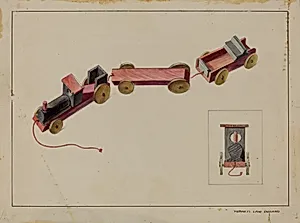
Toy Train
1935/1942
Medium
watercolor and graphite on paperboard
Dimensions
overall: 23 x 30.6 cm (9 1/16 x 12 1/16 in.) Original IAD Object: 9" long
Classification
Index of American Design
Department
CG-W
Museum
National Gallery of Art, Washington, D.C.
Credit
Index of American Design
Accession Number
1943.8.16665
Rights
Public Domain
Art Historical Context
**Toy Train** by Francis Law Durand captures the charm of American craftsmanship in a precise watercolor and graphite rendering on paperboard measuring 23 x 30.6 cm. Created between 1935 and 1942, this work depicts a classic toy train, originally about 9 inches long, the detailed engineering and playful design of everyday objects from America's past. Durand's meticulous technique blends soft watercolor washes for depth and texture with graphite lines for sharp outlines, bringing the toy's wooden form and metallic accents to life. This artwork is part of the ** of American Design**, a Federal Art Project under the Works Progress Administration (WPA) during the Great Depression. Launched in 1935, the IAD employed artists across the U.S. to document folk art, crafts, and decorative objects through over 15,000 watercolor plates, preserving cultural heritage at risk of being lost. Durand, based in Chicago, contributed numerous renderings that celebrated regional ingenuity. Housed in the National Gallery of Art, **Toy Train** exemplifies how toys reflected American values of innovation and whimsy, from 19th-century wooden models to early 20th-century trains inspired by railroads. It invites visitors to appreciate the artistry in humble playthings, bridging design history with nostalgic delight.
About the Artist
Francis Law Durand · 1855–present
**Francis Law Durand (1906–1995)** Born on March 31, 1906, in Mount Holly, New Jersey, Francis Law Durand emerged as a skilled American draftsman and artist during the Great Depression era. Little is known about his early life or formal training, as biographical details remain sparsely documented beyond his professional output. By 1935, he was employed by the Works Progress Administration (WPA), ...