
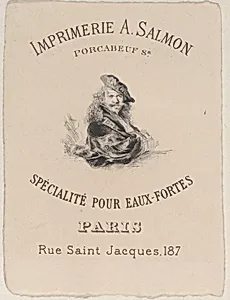
Trade Card for A. Salmon, Printer (Imprimeur)
Medium
Etching
Dimensions
Sheet: 4 1/16 × 3 1/16 in. (10.3 × 7.7 cm)
Classification
Prints|Ephemera
Department
Drawings and Prints
Museum
Metropolitan Museum of Art, New York, NY
Credit
Gift of Bella C. Landauer, 1926
Accession Number
26.28.412
Rights
Public Domain
Art Historical Context
This charming etching, titled *Trade Card for A Salmon, Printer (Imur)*, is a delightful example of 19th-century ephemera from around 1894. Created anonymously by a French artist, it served as a promotional trade card for the printing business of A. Salmon blending advertising with artistic flair. These small cards were widely collected during the Victorian era, functioning like modern business cards but often featuring exquisite illustrations to showcase a printer's skill. Measuring just over 4 by 3 inches, its compact size made it perfect for albums or shop counters. The work draws on the legacies of artists Auguste Porcabeuf and Rembrandt van Rijn, likely reproducing motifs from their oeuvres in a reproductive etching technique. Etching, an intaglio method where acid bites into a metal plate to create intricate lines, allowed for remarkable detail in such a tiny format—ideal for demonstrating A. Salmon's printing prowess. This fusion of commerce and high art highlights the era's booming print culture, where everyday objects became miniature masterpieces. Housed in the Metropolitan Museum of Art's Drawings and Prints department (gift of Bella C. Landauer, 1926), this piece offers a window into late 19th-century French commerce and the democratization of art through ephemera. Visitors will appreciate its whimsy and technical finesse, a testament to how printers elevated the mundane.
About the Artist
Anonymous, French, 19th century|Auguste Porcabeuf|Rembrandt (Rembrandt van Rijn) · 1800–1900
**Anonymous, French, 19th Century (ca. 1800–1900)** The artist cataloged as Anonymous, French, 19th century embodies the enigmatic yet essential contributions of unidentified creators to France's vibrant 19th-century art world. Active roughly between 1800 and 1900, this figure—or potentially collective workshop—produced a diverse array of works amid the nation's transition from Neoclassicism thro...