
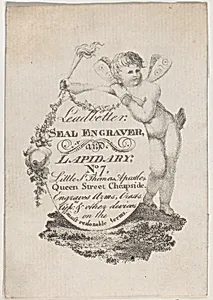
Trade Card for Leadbetter, Seal Engraver and Lapidary
19th century
Medium
Engraving
Dimensions
Sheet: 3 9/16 × 2 1/2 in. (9.1 × 6.3 cm)
Classification
Prints|Ephemera
Department
Drawings and Prints
Museum
Metropolitan Museum of Art, New York, NY
Credit
Gift of Bella C. Landauer, 1926
Accession Number
26.28.322
Rights
Public Domain
Art Historical Context
Step into the bustling world of 19th-century British commerce with this charming trade card, an anonymous engraving advertising the services of Leadbetter, a skilled seal engraver and lapidary. Measuring just 3 9/16 × 2 1/2 inches, this petite print exemplifies ephemera—those everyday printed items like business cards and ads that were once discarded but now offer a window into Victorian daily life. Produced via engraving, a meticulous technique where an artist incises fine lines into a metal plate, inks it, and presses paper to capture intricate details, the card likely features elegant typography and decorative motifs to showcase Leadbetter's craftsmanship in carving personalized seals and polishing gemstones. Trade cards like this one exploded in popularity during the Industrial Revolution, serving as portable promotions exchanged at markets, shops, or social events. They highlight the era's blend of artistry and entrepreneurship, where lapidaries crafted wax seals for letters and jewelry settings for the growing middle class. Seals were symbols of status and authenticity, essential before widespread photography or digital signatures. This example, gifted to the Metropolitan Museum of Art by Bella C. Landauer in 1926 and housed in the Drawings and Prints department, preserves a slice of overlooked graphic design history, reminding us how even tiny prints fueled economic and cultural vibrancy.
About the Artist
Anonymous, British, 19th century · 1800–1900
**Anonymous, British, 19th century** is not the name of a single individual but a standard museum attribution used for works whose creators remain unidentified yet are clearly British and date to the 1800s. Major institutions, including the Metropolitan Museum of Art, employ this designation for hundreds of drawings, prints, designs, and decorative studies that lack signatures or firm documentary ...