
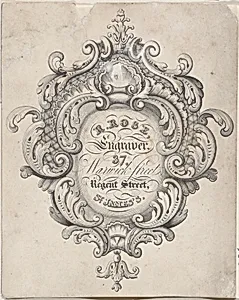
Trade Card for R. Rose, Engraver
19th century
Medium
Engraving
Dimensions
Sheet: 4 1/16 × 3 1/4 in. (10.3 × 8.2 cm)
Classification
Prints|Ephemera
Department
Drawings and Prints
Museum
Metropolitan Museum of Art, New York, NY
Credit
Gift of Bella C. Landauer, 1926
Accession Number
26.28.285
Rights
Public Domain
Art Historical Context
Step into the bustling world of 19th-century British commerce with this charming *Trade Card for R. Rose, Engr*. Produced anonymously in Britain during the Victorian era, this petite engraving measures just 4 1/16 × 3 1/4 inches, perfectly sized for tucking into a pocket or pasting into a scrapbook. As a piece of ephemera from the Metropolitan Museum of Art Drawings and Prints department—generously gifted by Bella C. Landauer in 1926—it offers a glimpse into everyday advertising culture. Trade cards like this one were the business cards of their time, widely distributed by artisans and shops to promote services. R. Rose, an engraver, specialized in the meticulous intaglio technique, where designs are incised into a metal plate, inked, and pressed onto paper to create sharp, durable lines ideal for illustrations, letterheads, and invitations. This card likely showcases Rose's own expertise, blending promotional function with artistic finesse amid the Industrial Revolution's print boom. Its cultural significance lies in preserving the craftsmanship of a trade on the cusp of mass production. Once discarded, these cards became coveted collectibles, revealing how engravers like Rose fueled Victorian visual culture—from fashion plates to calling cards—before photography and lithography transformed printing forever. A tiny testament to entrepreneurial spirit!
About the Artist
Anonymous, British, 19th century · 1800–1900
**Anonymous, British, 19th century** is not the name of a single individual but a standard museum attribution used for works whose creators remain unidentified yet are clearly British and date to the 1800s. Major institutions, including the Metropolitan Museum of Art, employ this designation for hundreds of drawings, prints, designs, and decorative studies that lack signatures or firm documentary ...