
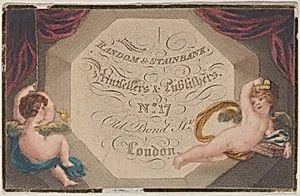
Trade Card for Random & Stainbeck, Printsellers & Publishers
19th century
Medium
Commercial Lithograph
Dimensions
Sheet: 2 11/16 × 4 3/16 in. (6.8 × 10.7 cm)
Classification
Prints|Ephemera
Department
Drawings and Prints
Museum
Metropolitan Museum of Art, New York, NY
Credit
Gift of Bella C. Landauer, 1926
Accession Number
26.28.304
Rights
Public Domain
Art Historical Context
This charming trade card, produced anonymously by a British artist in the 19th, advertises Random & Stainbeck, esteemed printsellers and publishers likely based in Victorian London. Measuring just 2 11/16 × 4 3/16 inches, these pocket-sized ephemera were the business cards of their era—distributed at trade shows, shops, or by mail to promote goods and build brand loyalty. As part of the Metropolitan Museum of Art's Drawings and collection, gifted by ephemera enthusiast Bella C. Landauer in 1926, it offers a glimpse into the everyday commerce that fueled Britain's industrial boom. Crafted as a commercial lithograph, the card exemplifies a revolutionary printing technique perfected in the 19th century. Lithography allowed for vibrant colors, intricate details, and affordable mass production, transforming advertising from plain text to eye-catching visuals. Though the specific imagery isn't detailed here, such cards often featured ornate borders, allegorical motifs, or product vignettes, blending artistry with commerce. Ephemera like this may seem humble, but they hold immense cultural value, revealing the rise of consumer culture and the democratization of art through prints. Collectors today treasure them as windows into a world where even the smallest paper promised big ambitions.
About the Artist
Anonymous, British, 19th century · 1800–1900
**Anonymous, British, 19th century** is not the name of a single individual but a standard museum attribution used for works whose creators remain unidentified yet are clearly British and date to the 1800s. Major institutions, including the Metropolitan Museum of Art, employ this designation for hundreds of drawings, prints, designs, and decorative studies that lack signatures or firm documentary ...